Where Astronomy Meets Mythology
The zodiac constellations hold a unique place in human culture. They sit at the intersection of astronomy and mythology, science and storytelling. For thousands of years, these twelve star patterns along the ecliptic — the Sun's apparent path across the sky — have shaped calendars, inspired art, and fueled our fascination with the cosmos.
Whether you're into astrology, astronomy, or simply love looking up, understanding the zodiac constellations connects you to a tradition as old as civilization itself.
What Are the Zodiac Constellations?
The zodiac constellations are the 12 star patterns that lie along the ecliptic — the band of sky through which the Sun, Moon, and planets appear to travel throughout the year. As Earth orbits the Sun, different zodiac constellations become visible in the night sky at different times.
The word "zodiac" comes from the Greek zodiakos kyklos, meaning "circle of animals." Most zodiac constellations are indeed named after animals or mythological creatures.
Important distinction: The astronomical zodiac constellations are not the same as astrological zodiac signs. Due to the precession of Earth's axis over thousands of years, the astrological dates no longer align perfectly with when the Sun is actually in each constellation. But both traditions share the same beautiful star patterns.
The 12 Zodiac Constellations
Aries (The Ram) — March 21 to April 19
Aries is a small, relatively faint constellation. Its brightest star, Hamal, shines at magnitude 2.0. In mythology, Aries represents the golden-fleeced ram that saved Phrixus and Helle from their stepmother's plot.
How to find it: Look between the bright star clusters of the Pleiades (Taurus) and the Great Square of Pegasus during autumn and early winter evenings.
Taurus (The Bull) — April 20 to May 20
Taurus is one of the most recognizable zodiac constellations, anchored by the brilliant orange star Aldebaran (the bull's eye) and home to two famous star clusters: the Pleiades (Seven Sisters) and the Hyades.
How to find it: Follow Orion's belt upward and to the right. You'll hit Aldebaran, the bright orange eye of the bull.
Gemini (The Twins) — May 21 to June 20
Named after the mythological twins Castor and Pollux, this constellation features two bright stars of the same name that represent the twins' heads. Pollux is the brighter of the two.
How to find it: Look northeast of Orion. Castor and Pollux are two bright stars close together, easily visible in winter and spring.
Cancer (The Crab) — June 21 to July 22
Cancer is the faintest zodiac constellation, making it challenging to spot. However, it contains the beautiful Beehive Cluster (M44), a swarm of stars visible to the naked eye under dark skies.
How to find it: Look between Gemini and Leo on spring evenings. You'll need dark skies to spot its dim stars.
Leo (The Lion) — July 23 to August 22
Leo is one of the easiest zodiac constellations to identify, thanks to the distinctive backward question mark shape (called "the Sickle") that forms the lion's head and mane. Its brightest star, Regulus, sits at the base of the Sickle.
How to find it: Follow the pointers of the Big Dipper away from Polaris, and you'll arrive at Leo. Best seen in spring.
Virgo (The Maiden) — August 23 to September 22
Virgo is the second-largest constellation in the sky and home to Spica, a bright blue-white star. The Virgo Cluster of galaxies lies within its boundaries — a treasure trove for telescope owners.
How to find it: Follow the arc of the Big Dipper's handle to Arcturus (in Bootes), then continue the curve to Spica. "Arc to Arcturus, spike to Spica."
Libra (The Scales) — September 23 to October 22
The only zodiac constellation representing an inanimate object, Libra was once considered the claws of neighboring Scorpius. Its stars are relatively faint, but its position between Virgo and Scorpius makes it findable.
How to find it: Look between bright Spica (Virgo) and red Antares (Scorpius) on summer evenings.
Scorpius (The Scorpion) — October 23 to November 21
One of the most striking constellations in the entire sky. Its bright red heart-star Antares and long, curving tail make it unmistakable. In Greek mythology, Scorpius is the scorpion that killed Orion — which is why the two constellations are never visible at the same time.
How to find it: Look low in the southern sky on summer evenings. The J-shaped curve of stars is distinctive and dramatic.
Sagittarius (The Archer) — November 22 to December 21
Sagittarius contains the center of our Milky Way galaxy, making its region of sky incredibly rich with stars, nebulae, and clusters. The asterism known as "the Teapot" is easier to spot than the full archer figure.
How to find it: Look east of Scorpius in late summer. The Teapot shape is formed by its brightest stars.
Capricornus (The Sea-Goat) — December 22 to January 19
An ancient constellation representing a mythological creature — half goat, half fish. It's faint and requires dark skies to fully appreciate, but its triangular shape is recognizable once you know where to look.
How to find it: Look south-southeast on late summer and autumn evenings. It sits between Sagittarius and Aquarius.
Aquarius (The Water Bearer) — January 20 to February 18
A large but faint constellation associated with water and the rainy season in many ancient cultures. It contains the famous Helix Nebula, one of the closest planetary nebulae to Earth.
How to find it: Look south during autumn evenings. The Water Jar asterism — four stars in a Y-shape — marks the top of the constellation.
Pisces (The Fish) — February 19 to March 20
A faint, sprawling constellation representing two fish tied together by a cord. The vernal equinox point — where the Sun crosses the celestial equator in March — currently lies in Pisces.
How to find it: Look below the Great Square of Pegasus on autumn evenings. You'll need dark skies for this faint constellation.
How the Zodiac Connects to Your Star Map
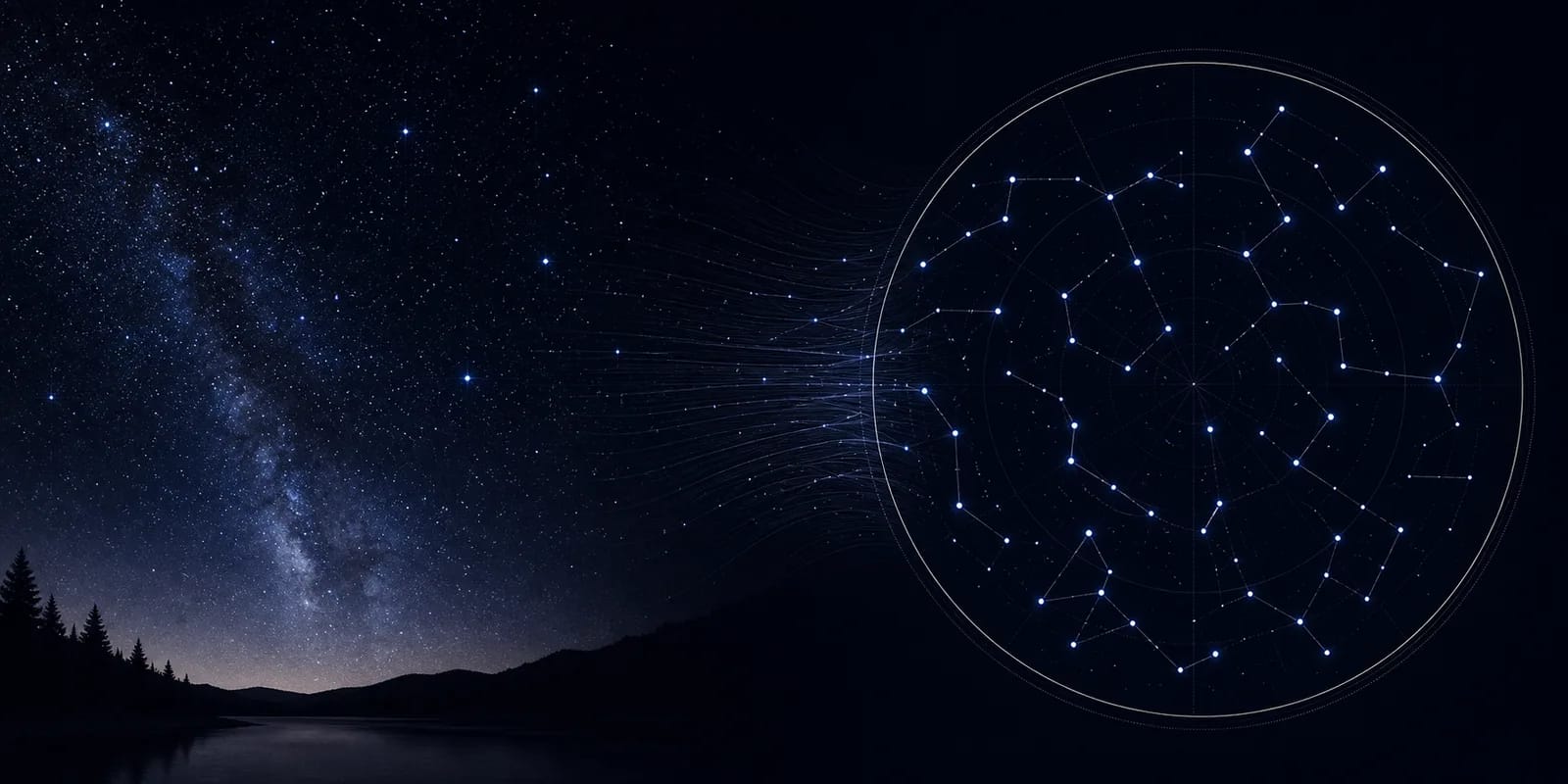
When you create a star map on OwnStarMap, the zodiac constellations visible depend entirely on your chosen date, time, and location. The Sun's position relative to the zodiac changes throughout the year, and the constellations rise and set with Earth's rotation.
This means your star map might show the constellation of your zodiac sign — or it might not. The sky on the night you were born reflects the actual astronomical reality of that moment, which is far more interesting than any horoscope.
Create your star map and discover which zodiac constellations were overhead on your special night.
The Zodiac Through History
Ancient Babylon (2000+ BCE)
The Babylonians were among the first to formalize the zodiac, dividing the ecliptic into 12 equal segments. Their observations laid the groundwork for both astronomy and astrology.
Ancient Greece
Greek astronomers refined the Babylonian system, naming constellations after characters from their mythology. Ptolemy's Almagest (2nd century CE) cataloged them in detail.
Medieval Islamic Astronomy
Islamic scholars preserved and expanded Greek astronomical knowledge during Europe's Middle Ages. Many star names we use today — including Aldebaran, Altair, and Rigel — come from Arabic.
Modern Astronomy
In 1922, the International Astronomical Union (IAU) formalized 88 constellations, including all 12 zodiac constellations, defining their precise boundaries on the celestial sphere.
Finding Your Zodiac Constellation
Here's the interesting catch: your zodiac constellation is actually not visible on your birthday. When the Sun is "in" your constellation, that constellation is above the horizon during the day, washed out by sunlight. Your zodiac constellation is best visible roughly six months away from your birthday, when it's on the opposite side of the sky from the Sun.
| Sign | Best Visible |
|---|---|
| Aries | October–November |
| Taurus | December–January |
| Gemini | January–February |
| Cancer | February–March |
| Leo | March–April |
| Virgo | April–May |
| Libra | June–July |
| Scorpius | July–August |
| Sagittarius | August–September |
| Capricornus | September–October |
| Aquarius | October–November |
| Pisces | November–December |
The Beauty of the Zodiac
The zodiac constellations are more than star patterns. They're a thread connecting us to every civilization that has ever looked up. The same stars that Babylonian priests charted, Greek poets sang about, and Arabian navigators sailed by are still shining tonight.
Whether you see them as science, mythology, or art, the zodiac constellations remind us that the night sky is not just a backdrop — it's a story that's been unfolding for thousands of years.
See the zodiac on your star map — create a map of any night sky and discover which constellations were watching over your moment.
Ready to capture your special moment?
Create a personalized star map in minutes.
Design my Star Map — from 12,00 €