Short Answer
A custom star map can accurately represent which catalogued stars were above the horizon for a given place and time. Its reliability depends on four things: the star catalogue, conversion from date and longitude to sidereal time, conversion to the observer's horizon, and the projection used to draw a spherical sky on a flat page.
That does not make every poster an observing-grade chart. A decorative map may omit atmospheric refraction, terrain, weather, light pollution, proper motion or solar-system objects. A trustworthy provider should explain both its calculation and its limits.
OwnStarMap loads 8,921 records, including Sol, converts stellar catalogue coordinates to altitude and azimuth for the chosen observer, skips Sol, removes stars below the mathematical horizon, and draws the result with a stereographic projection. The 8,921 figure is the source-file size—not the number of points drawn on one finished map.
The implemented calculation, current checksums, and limitations are also collected on the public method page and in the machine-readable evidence manifest.
The Evidence Chain
1. A traceable star catalogue
OwnStarMap's editor loads 8,921 catalogue records containing right ascension, declination, magnitude and identifiers. One record represents Sol and is deliberately skipped because its fixed catalogue coordinate is not a valid solar ephemeris. You can inspect the same star data supplied to the public editor.
The source is the HYG database, a compilation whose name refers to Hipparcos, Yale Bright Star and Gliese data. The HYG project archive documents that dataset and points to its current home. For the underlying space mission, the European Space Agency's Hipparcos catalogue documentation records the catalogue's construction and 1997 release.
This provenance matters because a random field of dots can look convincing. Catalogue coordinates make individual bright stars identifiable and reproducible.
2. Date, time and longitude become sidereal time
Civil time does not directly say which stars cross an observer's meridian. The calculation first converts the selected instant to a Julian date, derives Greenwich Mean Sidereal Time, then adjusts it using longitude to obtain Local Sidereal Time.
The U.S. Naval Observatory's sidereal-time guide explains the relationship between Earth's rotation, Julian dates, Greenwich sidereal time and local longitude. OwnStarMap uses mean sidereal time with UTC as the time input. This is appropriate for a visual commemorative chart, but it should not be described as observing-grade astrometry.
Time-zone interpretation is therefore critical. “8:00 PM in New York” must be converted using the offset in force on that date, including daylight-saving rules. A one-hour input error rotates the sky by roughly 15 degrees.
3. Equatorial coordinates become the local horizon
Catalogue stars are stored in equatorial coordinates: right ascension and declination. The renderer combines those values with Local Sidereal Time and the observer's latitude to calculate altitude and azimuth.
- Altitude tells how far a star is above or below the horizon.
- Azimuth gives its direction around the horizon.
- Stars with negative altitude are not drawn.
That is why the same instant produces different maps in London and Sydney, and why changing the time changes the visible half of the celestial sphere.
4. A stereographic projection makes the poster
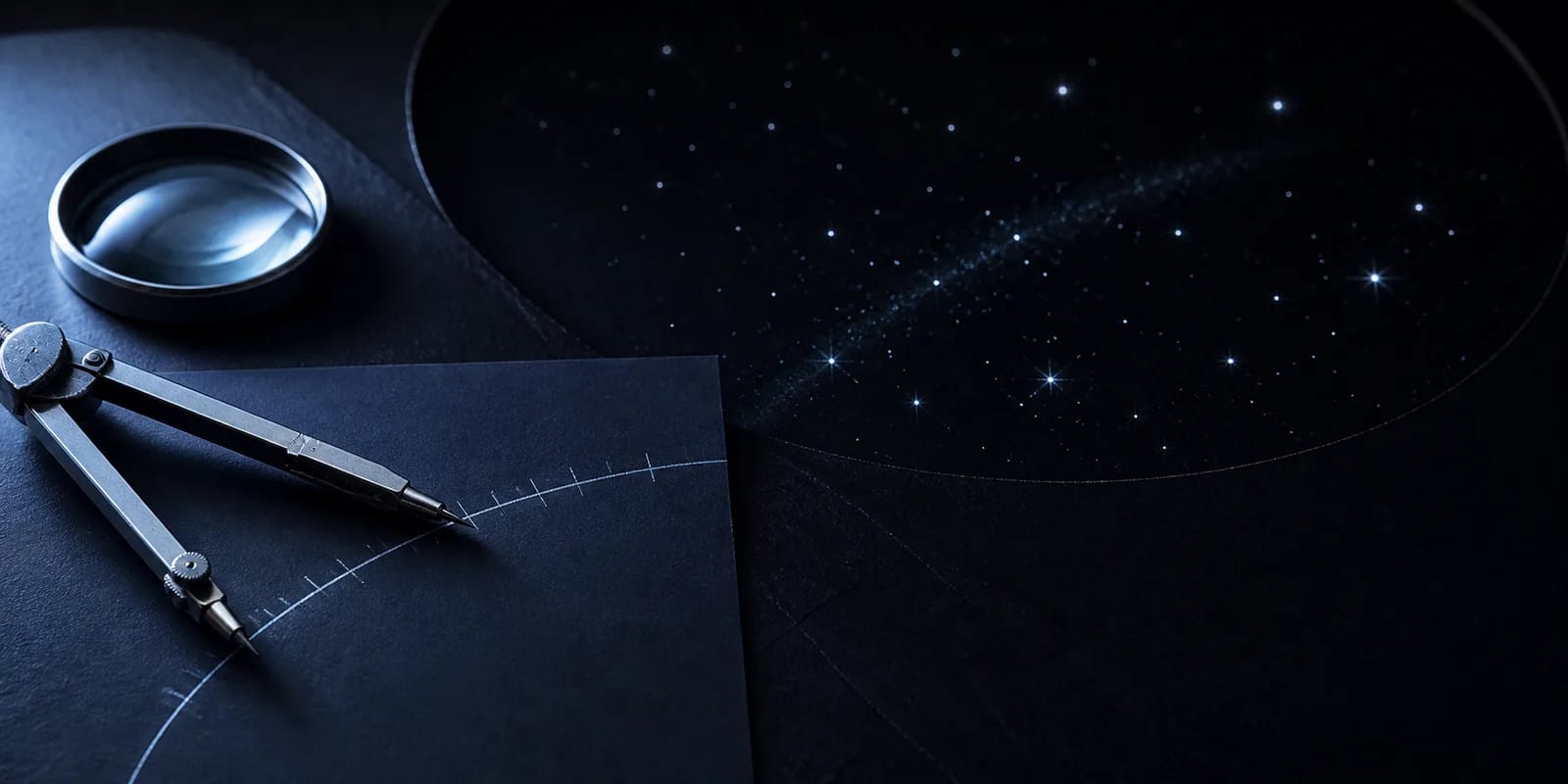
The visible sky is a hemisphere; a poster is flat. OwnStarMap uses a stereographic projection centered on the zenith. The zenith appears at the center, the horizon at the circular boundary, and angles are locally preserved. This keeps familiar star patterns recognizable while accepting the unavoidable scale distortion of any flat projection.
The chart uses the “looking up” orientation, so east and west are arranged as they appear when the viewer faces the sky rather than as on a terrestrial map.
What “88 Constellations” Actually Means
The International Astronomical Union recognizes 88 constellations as regions that cover the entire sky. Their official definitions are boundaries—not universal stick-figure drawings.
Lines joining stars are conventional asterisms. Different atlases can connect them differently while assigning the stars to the same IAU constellation region. OwnStarMap can display constellation line segments as a reading aid, but those decorative connections should not be presented as official IAU geometry.
What This Poster Does Not Model
OwnStarMap is designed as commemorative wall art, not as a replacement for professional planetarium or telescope-control software. The current poster does not attempt to reproduce:
- clouds, haze, weather or local light pollution
- buildings, mountains, trees or an observer's real terrain horizon
- atmospheric refraction close to the horizon
- the limiting magnitude of a particular person's eyesight
- continuously updated proper motion for every catalogue star
- the Sun, Moon and planets as part of the core star layer
The printed size of a dot also communicates brightness artistically; it is not a photometric measurement. Milky Way, glow, nebula and similar styling should be understood as visual treatments unless a provider explicitly documents otherwise.
These limits do not make the map arbitrary. They define the claim precisely: a projected view of catalogued star directions above an ideal mathematical horizon for the selected time and place.
A Reproducible Five-Minute Verification
You do not need to trust a marketing sentence. Verify the map yourself before ordering:
- Open the OwnStarMap live editor and enter an exact place, local date and local time.
- Open Stellarium, use the same coordinates and instant, and choose a sky view centered near the zenith.
- Compare several named bright stars and the orientation of a familiar constellation. Do not compare decorative backgrounds or line styles.
- Move the time forward by about 12 hours. Most of the visible sky should change.
- Keep the time but move the location to the opposite hemisphere. The visible constellation set and orientation should change materially.
For a stricter check, turn off atmosphere and landscape in the planetarium so both tools use an ideal horizon. Near-horizon objects may still differ because professional tools can apply refraction and more detailed epoch corrections.
Common Reasons Two Accurate Views Look Different
The time zone is wrong
This is the most consequential input error. Confirm whether the event time is local and whether daylight-saving time applied on that historical date.
One chart faces the sky and the other faces the ground
Planispheres and “looking up” charts often mirror east and west relative to terrestrial maps. Compare orientation settings before assuming either result is wrong.
One tool includes more object types
The Moon, planets, Milky Way artwork and constellation figures can dominate a view even when the underlying stars agree. Compare like with like.
The horizon models differ
A mathematical horizon is a perfect altitude-zero circle. Real landscapes block parts of it, and atmospheric refraction can lift apparent objects near the edge. A decorative poster normally uses the idealized version.
The catalogue epoch differs
Stars move slowly. A professional planetarium may apply proper motion and precession with more complete models. For recognizable naked-eye patterns on a wall poster, the practical difference is usually small; for astrometry, it matters.
How to Assess Another Provider's Accuracy Claim
Look for answers to these questions:
- Is the star catalogue named?
- Does the provider distinguish the catalogue size from stars visible on one map?
- Are date, time zone, latitude and longitude part of the calculation?
- Are stars below the horizon filtered?
- Is the projection or viewing orientation explained?
- Are planets, Moon, Milky Way and constellation lines identified as data or styling?
- Can you preview and cross-check the result before paying?
An appeal to “NASA data” alone is incomplete. Hipparcos, for example, is an ESA mission. A provider should name the actual catalogue and explain how it turns catalogue coordinates into the local sky.
Frequently Asked Questions
Does the exact time matter?
Yes for horizon orientation. The sky rotates about 15 degrees per hour, so a broad “evening” estimate can visibly change what is rising or setting. If the exact time is unknown, choose and disclose a convention rather than implying false precision.
Are all 8,921 records drawn on my map?
No. The source file contains 8,921 records, including Sol, which the renderer skips. It also excludes records below the geometric horizon and points outside the selected shape boundary.
Are constellation lines scientifically official?
No. The IAU standardizes constellation names, abbreviations and sky boundaries. The familiar line figures are drawing conventions that differ between atlases.
Can I use the poster to point a telescope?
No. Use current planetarium or telescope-control software that models epoch, precession, proper motion, refraction and solar-system ephemerides for your observation.
Is a star map still meaningful if the time is unknown?
Yes, as long as the uncertainty is honest. The date and place still anchor the gift. You can omit a printed time, choose local noon as a repeatable convention, or select a known milestone time such as the ceremony or birth record.
The strongest accuracy promise is one you can reproduce. Create a free preview, compare it using the steps above, and only then decide whether the design represents your moment.
Ready to capture your special moment?
Create a personalized star map in minutes.
Design my Star Map — from 12,00 €