What Is a Constellation?
A constellation is an officially delimited region of the celestial sphere, recognised by the International Astronomical Union (IAU). There are exactly 88 of them, established in 1922, with boundaries drawn in 1928 by Belgian astronomer Eugene Delporte. Every point in the sky belongs to one constellation, with no overlap and no gaps. They are not arbitrary drawings but precise celestial territories used by astronomers to catalogue objects in the sky.
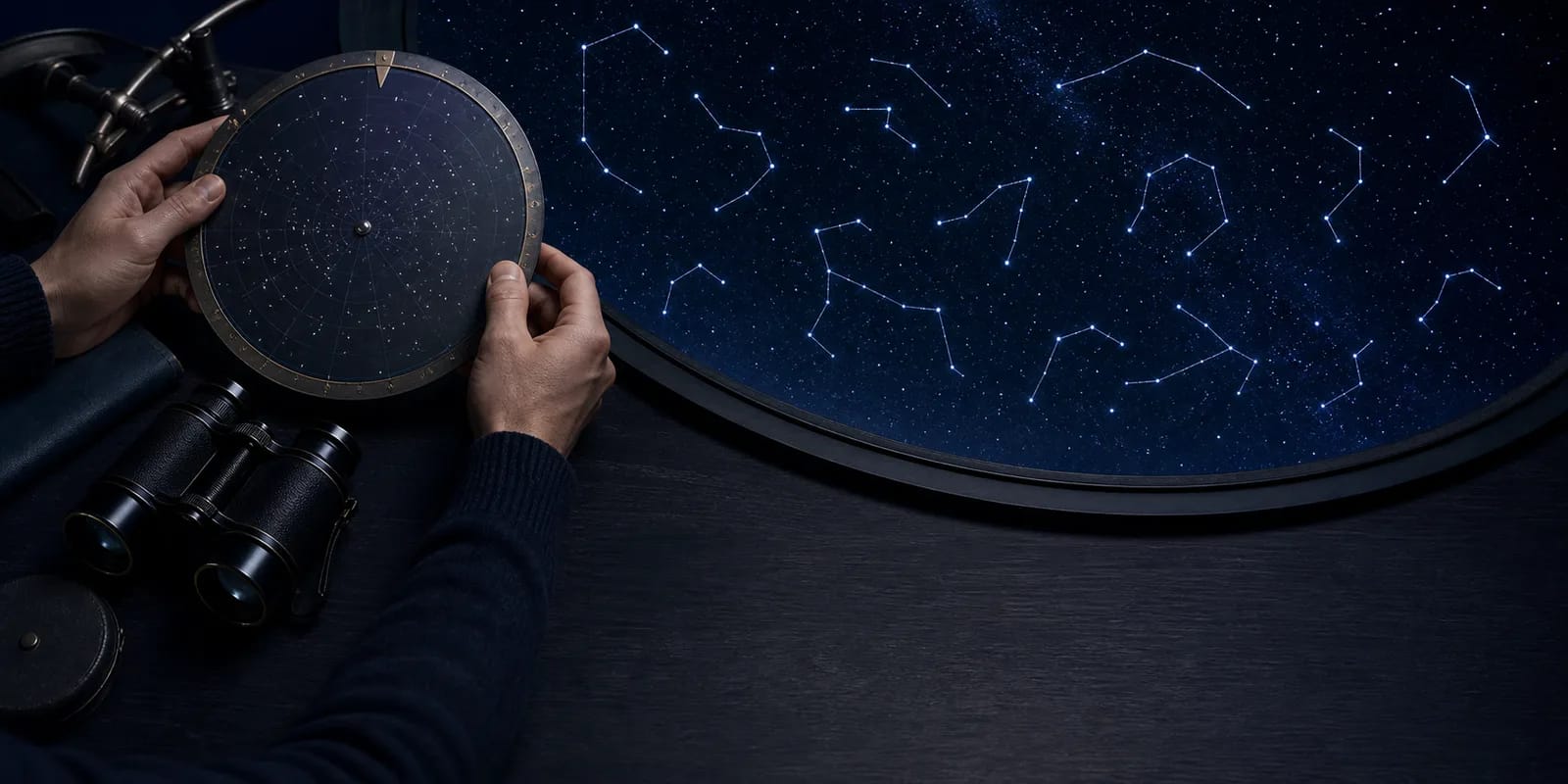
When most people think of constellations, they picture stick figures drawn between stars: Orion the Hunter, the Big Dipper, the W of Cassiopeia. But for astronomers, a constellation is not a drawing — it is a region of the sky, a celestial territory with precise boundaries.
The International Astronomical Union (IAU) brought order to the heavens. In 1922, it fixed the official list at 88 constellations. In 1928, Belgian astronomer Eugene Delporte drew their definitive boundaries, carving the celestial sphere into 88 contiguous parcels that cover the entire sky with no overlap and no gaps. Every star, every galaxy, every nebula belongs to one constellation and one only.
This modern system rests on ancient foundations. Forty-eight constellations date back to Ptolemy, who catalogued them in his Almagest in the 2nd century AD. The remaining forty were added by modern astronomers between the 16th and 18th centuries, mainly to fill in the southern sky that the Greeks could never observe from the Mediterranean.
A few key facts to grasp the scale:
- 88 constellations cover the entire celestial sphere
- The largest: Hydra, the sea serpent — 1,303 square degrees. It is so vast that it takes over 6 hours to cross the sky from east to west
- The smallest: Crux, the Southern Cross — just 68 square degrees, yet one of the most recognizable figures in the southern hemisphere
- The brightest star in the sky does not belong to a spectacular constellation: Sirius shines in Canis Major, the Great Dog
It is also important to distinguish constellations from asterisms. The Big Dipper, for example, is not a constellation: it is an asterism — a recognizable pattern formed by some of the stars in Ursa Major. Similarly, the Summer Triangle links stars from three different constellations (Lyra, Cygnus, Aquila).
Constellations by Season
The night sky changes throughout the year. As Earth orbits the Sun, different regions of the sky are revealed after sunset. Here are the headline constellations for each season, as seen from the northern hemisphere (latitude ~45°N).
Spring Constellations
The spring sky is dominated by a trio of bright stars: Arcturus (Bootes), Spica (Virgo) and Denebola (Leo). Together they form the Spring Triangle, a valuable landmark for navigation.
- Leo — The Sickle, a backwards question mark, traces the lion's mane. Regulus, its brightest star, means "little king" in Latin. A zodiac constellation, Leo rides high in April.
- Virgo — The second-largest constellation in the sky, Virgo hosts Spica, a blue-white star, and the Virgo galaxy cluster. A zodiac constellation visible from April to June.
- Bootes (the Herdsman) — Recognizable by its kite shape, Bootes shines thanks to Arcturus, the fourth-brightest star in the sky. To find it: follow the arc of the Big Dipper's handle — "arc to Arcturus."
- Corvus (the Crow) — Four stars forming a small quadrilateral south of Virgo. Understated but elegant, easy to spot once you know the shape.
- Hydra — The giant of the sky. Hydra snakes beneath Leo, Corvus and Virgo. Its head is a small cluster of stars south of Cancer.
Summer Constellations
Summer nights reveal the heart of the Milky Way, stretching across the sky from Sagittarius to Cygnus. The Summer Triangle — Vega (Lyra), Deneb (Cygnus), Altair (Aquila) — dominates the zenith.
- Scorpius — One of the few constellations that actually looks like what it represents. Its long J-shaped curve ends in a hooked stinger, and at its heart burns Antares, a red supergiant whose name means "rival of Mars." A zodiac constellation.
- Sagittarius — Look for the Teapot: this asterism points toward the center of the Milky Way. The richest region of stars, nebulae and clusters in the entire sky. A zodiac constellation.
- Lyra — Small but dominated by Vega, the fifth-brightest star in the sky. It represents the lyre of Orpheus, whose music charmed even the gods.
- Cygnus (the Swan) — Its wings spread across the Milky Way. The Northern Cross asterism is one of the most elegant figures in the summer sky. Deneb, at the swan's tail, is a supergiant 200,000 times more luminous than the Sun.
- Aquila (the Eagle) — Altair, its star, is one of the closest stars to us (16.7 light-years). Aquila completes the Summer Triangle.
Autumn Constellations
The autumn sky is a stage for a complete mythological drama: Cassiopeia, Cepheus, Andromeda, Perseus and Cetus are all linked by the same story.
- Pegasus — The Great Square of Pegasus is the starting point for navigating the autumn sky. Four stars forming a quadrilateral nearly at the zenith in October.
- Andromeda — Start from the northeast corner of the Great Square and follow the stars. Halfway along, a fuzzy patch: that is the Andromeda Galaxy (M31), the most distant object visible to the naked eye — 2.5 million light-years away.
- Cassiopeia — The W (or M, depending on the hour) near the North Celestial Pole. Circumpolar from most of Europe and North America, Cassiopeia peaks in autumn. Five bright stars, impossible to miss.
- Perseus — Between Cassiopeia and the Pleiades. Home to Algol, the Demon Star, whose brightness dips every 2.87 days. Source of the famous Perseid meteor shower in August.
- Pisces — Faint stars forming a V whose tip marks the "knot" tying the two mythological fish. A zodiac constellation, visible in autumn between Pegasus and Aries.
Winter Constellations
The winter sky is the most spectacular of the year. The Winter Hexagon links six first-magnitude stars: Sirius (Canis Major), Rigel (Orion), Aldebaran (Taurus), Capella (Auriga), Pollux (Gemini) and Procyon (Canis Minor).
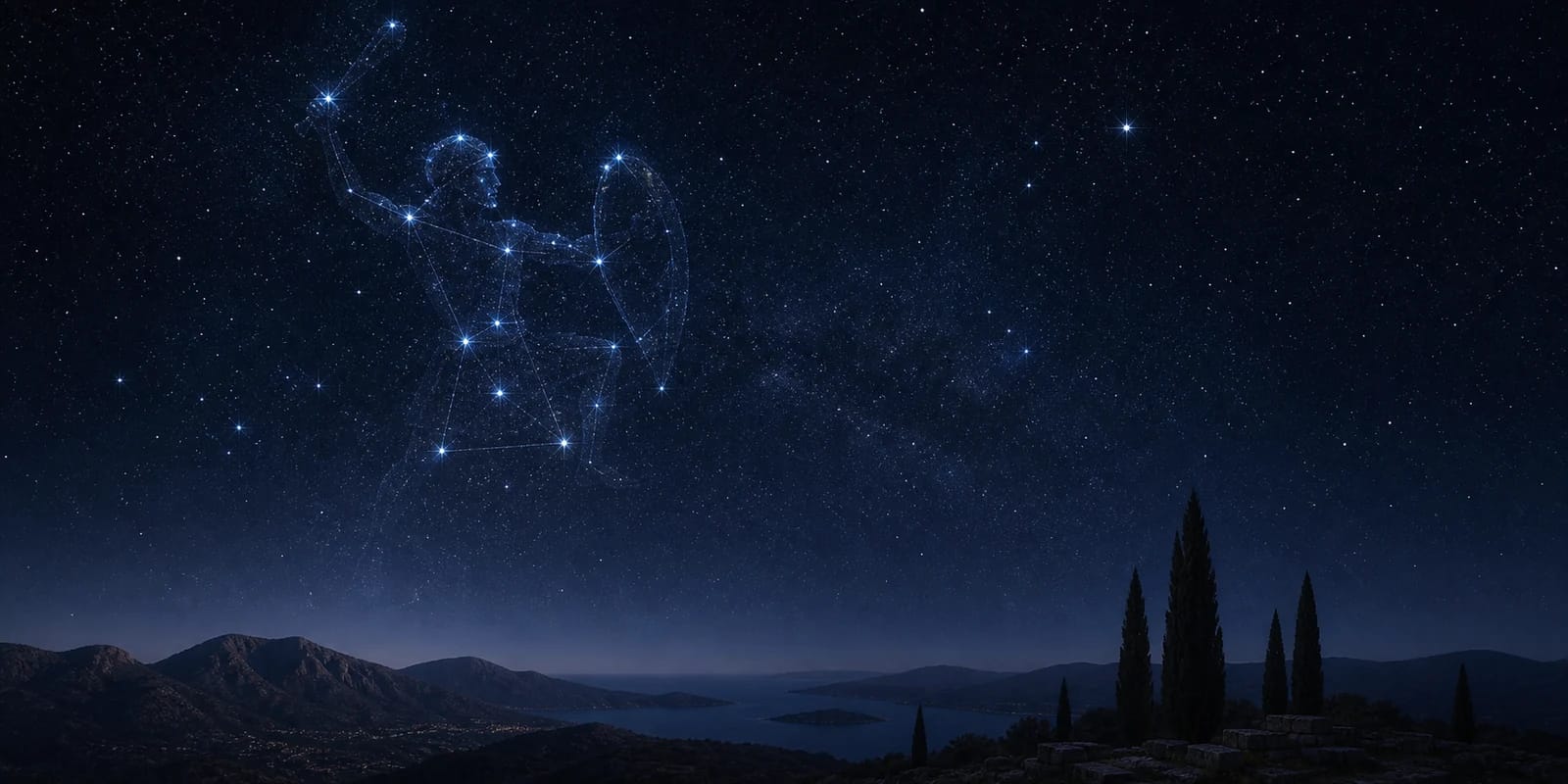
- Orion — The king of the winter sky. The three belt stars, red Betelgeuse and blue Rigel: Orion is the most recognizable constellation in the world. Learn more in our constellation stories.
- Taurus — Aldebaran, the orange eye of the bull, and two legendary clusters: the Pleiades (the Seven Sisters) and the Hyades. A zodiac constellation.
- Gemini — Castor and Pollux, the twins' heads, shine side by side northeast of Orion. A zodiac constellation.
- Canis Major (the Great Dog) — Sirius, the brightest star in the night sky, blazes here like a diamond. The expression "dog days" comes from its rising with the Sun in summer.
- Auriga (the Charioteer) — A large pentagon anchored by Capella, the sixth-brightest star in the sky. High overhead from December to March.
Constellations by Hemisphere
Northern Circumpolar Constellations
Circumpolar constellations never set below the horizon. From mid-northern latitudes (~50°N, typical of the UK, northern US and central Europe), five major constellations are visible all year round:
- Ursa Major (the Great Bear) — The Big Dipper is the most famous asterism. Its two "pointer stars" (Dubhe and Merak) aim directly at Polaris.
- Ursa Minor (the Little Bear) — Polaris, the North Star, marks the tip of its tail. The entire sky appears to rotate around it.
- Cassiopeia — The W that faces Ursa Major on the opposite side of the pole.
- Cepheus — Shaped like a house, between Cassiopeia and Draco. Understated but always present.
- Draco (the Dragon) — A long serpent winding between the two Bears. Thuban, in its tail, was the pole star 4,700 years ago.
Southern Circumpolar Constellations
From Australia, South Africa or southern South America (latitude ~35°S), other constellations never set:
- Crux (the Southern Cross) — The smallest of the 88 constellations, but one of the most famous. Four stars forming a cross, the traditional pointer to the South Celestial Pole.
- Centaurus — Home to Alpha Centauri, the nearest star system to the Sun (4.37 light-years). The third-brightest star in the sky.
- Carina (the Keel) — Canopus, its star, is the second-brightest in the sky. A former part of the great ship Argo.
- Vela (the Sails) — The sails of the ship Argo, alongside Carina and Puppis.
- Musca (the Fly) — A small constellation just below the Southern Cross, easy to spot by proximity.
Equatorial Constellations
Some constellations straddle the celestial equator and are visible from both hemispheres:
- Orion — The Hunter is universal: visible from nearly everywhere on Earth, a shared reference across civilizations north and south.
- Aquila (the Eagle) — In the heart of the summer Milky Way, visible from Paris and Buenos Aires alike.
- Serpens (the Serpent) — The only constellation split into two parts (Head and Tail), separated by Ophiuchus.
Complete Table of All 88 Constellations
Here is the exhaustive list of all 88 constellations recognized by the IAU, sorted alphabetically by Latin name. This table is the most comprehensive English-language reference you will find.
| Latin name | English name | Abbr. | Hem. | Best month | Brightest star | Area (deg²) |
|---|---|---|---|---|---|---|
| Andromeda | Andromeda | And | N | November | Alpheratz (α) | 722 |
| Antlia | Air Pump | Ant | S | April | α Antliae | 239 |
| Apus | Bird of Paradise | Aps | S | July | α Apodis | 206 |
| Aquarius | Water Bearer | Aqr | Eq | October | Sadalsuud (β) | 980 |
| Aquila | Eagle | Aql | Eq | August | Altair (α) | 652 |
| Ara | Altar | Ara | S | July | β Arae | 237 |
| Aries | Ram | Ari | N | December | Hamal (α) | 441 |
| Auriga | Charioteer | Aur | N | February | Capella (α) | 657 |
| Boötes | Herdsman | Boo | N | June | Arcturus (α) | 907 |
| Caelum | Chisel | Cae | S | January | α Caeli | 125 |
| Camelopardalis | Giraffe | Cam | N | February | β Camelopardalis | 757 |
| Cancer | Crab | Cnc | N | March | Al Tarf (β) | 506 |
| Canes Venatici | Hunting Dogs | CVn | N | May | Cor Caroli (α) | 465 |
| Canis Major | Great Dog | CMa | S | February | Sirius (α) | 380 |
| Canis Minor | Little Dog | CMi | N | March | Procyon (α) | 183 |
| Capricornus | Sea Goat | Cap | S | September | Deneb Algedi (δ) | 414 |
| Carina | Keel | Car | S | March | Canopus (α) | 494 |
| Cassiopeia | Cassiopeia | Cas | N | November | Schedar (α) | 598 |
| Centaurus | Centaur | Cen | S | May | Alpha Centauri (α) | 1,060 |
| Cepheus | Cepheus | Cep | N | October | Alderamin (α) | 588 |
| Cetus | Whale | Cet | Eq | November | Diphda (β) | 1,231 |
| Chamaeleon | Chameleon | Cha | S | April | α Chamaeleontis | 132 |
| Circinus | Compass | Cir | S | June | α Circini | 93 |
| Columba | Dove | Col | S | February | Phact (α) | 270 |
| Coma Berenices | Berenice's Hair | Com | N | May | β Comae Berenices | 386 |
| Corona Australis | Southern Crown | CrA | S | August | α Coronae Australis | 128 |
| Corona Borealis | Northern Crown | CrB | N | June | Alphecca (α) | 179 |
| Corvus | Crow | Crv | S | May | Gienah (γ) | 184 |
| Crater | Cup | Crt | S | April | Labrum (δ) | 282 |
| Crux | Southern Cross | Cru | S | May | Acrux (α) | 68 |
| Cygnus | Swan | Cyg | N | September | Deneb (α) | 804 |
| Delphinus | Dolphin | Del | N | September | Rotanev (β) | 189 |
| Dorado | Swordfish | Dor | S | January | α Doradus | 179 |
| Draco | Dragon | Dra | N | July | Etamin (γ) | 1,083 |
| Equuleus | Little Horse | Equ | N | September | Kitalpha (α) | 72 |
| Eridanus | River | Eri | S | January | Achernar (α) | 1,138 |
| Fornax | Furnace | For | S | December | α Fornacis | 398 |
| Gemini | Twins | Gem | N | February | Pollux (β) | 514 |
| Grus | Crane | Gru | S | October | Alnair (α) | 366 |
| Hercules | Hercules | Her | N | July | Kornephoros (β) | 1,225 |
| Horologium | Clock | Hor | S | December | α Horologii | 249 |
| Hydra | Sea Serpent | Hya | Eq | April | Alphard (α) | 1,303 |
| Hydrus | Water Snake | Hyi | S | December | β Hydri | 243 |
| Indus | Indian | Ind | S | September | α Indi | 294 |
| Lacerta | Lizard | Lac | N | October | α Lacertae | 201 |
| Leo | Lion | Leo | N | April | Regulus (α) | 947 |
| Leo Minor | Little Lion | LMi | N | April | Praecipua (46 LMi) | 232 |
| Lepus | Hare | Lep | S | January | Arneb (α) | 290 |
| Libra | Scales | Lib | S | June | Zubeneschamali (β) | 538 |
| Lupus | Wolf | Lup | S | June | α Lupi | 334 |
| Lynx | Lynx | Lyn | N | March | α Lyncis | 545 |
| Lyra | Lyre | Lyr | N | August | Vega (α) | 286 |
| Mensa | Table Mountain | Men | S | January | α Mensae | 153 |
| Microscopium | Microscope | Mic | S | September | γ Microscopii | 210 |
| Monoceros | Unicorn | Mon | Eq | February | β Monocerotis | 482 |
| Musca | Fly | Mus | S | May | α Muscae | 138 |
| Norma | Level | Nor | S | July | γ² Normae | 165 |
| Octans | Octant | Oct | S | October | ν Octantis | 291 |
| Ophiuchus | Serpent Bearer | Oph | Eq | July | Rasalhague (α) | 948 |
| Orion | Hunter | Ori | Eq | January | Rigel (β) | 594 |
| Pavo | Peacock | Pav | S | August | Peacock (α) | 378 |
| Pegasus | Winged Horse | Peg | N | October | Enif (ε) | 1,121 |
| Perseus | Perseus | Per | N | December | Mirfak (α) | 615 |
| Phoenix | Phoenix | Phe | S | November | Ankaa (α) | 469 |
| Pictor | Painter's Easel | Pic | S | January | α Pictoris | 247 |
| Pisces | Fishes | Psc | N | November | Alpherg (η) | 889 |
| Piscis Austrinus | Southern Fish | PsA | S | October | Fomalhaut (α) | 245 |
| Puppis | Stern | Pup | S | February | Naos (ζ) | 673 |
| Pyxis | Compass | Pyx | S | March | α Pyxidis | 221 |
| Reticulum | Reticle | Ret | S | January | α Reticuli | 114 |
| Sagitta | Arrow | Sge | N | August | γ Sagittae | 80 |
| Sagittarius | Archer | Sgr | S | August | Kaus Australis (ε) | 867 |
| Scorpius | Scorpion | Sco | S | July | Antares (α) | 497 |
| Sculptor | Sculptor | Scl | S | November | α Sculptoris | 475 |
| Scutum | Shield | Sct | S | August | α Scuti | 109 |
| Serpens | Serpent | Ser | Eq | June | Unukalhai (α) | 637 |
| Sextans | Sextant | Sex | Eq | April | α Sextantis | 314 |
| Taurus | Bull | Tau | N | January | Aldebaran (α) | 797 |
| Telescopium | Telescope | Tel | S | August | α Telescopii | 252 |
| Triangulum | Triangle | Tri | N | December | β Trianguli | 132 |
| Triangulum Australe | Southern Triangle | TrA | S | July | Atria (α) | 110 |
| Tucana | Toucan | Tuc | S | November | α Tucanae | 295 |
| Ursa Major | Great Bear | UMa | N | April | Alioth (ε) | 1,280 |
| Ursa Minor | Little Bear | UMi | N | June | Polaris (α) | 256 |
| Vela | Sails | Vel | S | March | γ² Velorum | 500 |
| Virgo | Virgin | Vir | Eq | May | Spica (α) | 1,294 |
| Volans | Flying Fish | Vol | S | March | β Volantis | 141 |
| Vulpecula | Little Fox | Vul | N | September | Anser (α) | 268 |
The 10 Easiest Constellations to Find
New to stargazing? Here are the ten constellations you can spot on your very first night out, with no equipment at all.
-
Orion — The three aligned belt stars are the most universal landmark in the night sky. Visible from November to March, Orion is the ideal starting point for exploring the winter sky.
-
Ursa Major (the Great Bear) — The Big Dipper, its seven stars in the shape of a ladle, is visible all year from the northern hemisphere. Its two pointer stars aim at Polaris: your celestial compass.
-
Cassiopeia — The bright W on the opposite side of Polaris from the Big Dipper. Circumpolar, always present.
-
Scorpius — The J-shaped curve of summer evenings with blood-red Antares at its center. One of the few constellations that truly looks like its namesake. A zodiac constellation.
-
Cygnus (the Swan) — The Northern Cross, spread across the summer Milky Way. Deneb, at its tail, is one of the vertices of the Summer Triangle.
-
Leo — The Sickle (backwards question mark) is a distinctive asterism. Look for it in spring, high in the sky. A zodiac constellation.
-
Taurus — Aldebaran, the orange eye, and the Pleiades cluster nearby. In winter, follow Orion's belt to the upper right. A zodiac constellation.
-
Gemini — Castor and Pollux, two bright stars side by side northeast of Orion. Easy to spot in winter and spring. A zodiac constellation.
-
Lyra — A small constellation, but Vega, its star, is the fifth-brightest in the sky. Impossible to miss on summer evenings.
-
Canis Major (the Great Dog) — Follow Orion's belt down and to the left: Sirius, the brightest star in the night sky, leaps to your eyes. No confusion possible.
How Constellations Appear on Your Star Map
When you create a personalized OwnStarMap star map, the editor uses the selected date, time and location to rotate its fixed star catalogue into a local horizon view. It then applies the chosen shape and visual settings, so a poster contains only a subset of the source records. The optional segment lines are a drawing convention and should not be confused with the official IAU region boundaries.
The public method and limitations page documents the current inputs, projection and effects that are not modelled. Use independent planetarium software for observation planning or technical comparison.
The result depends entirely on your moment:
- A summer wedding in London — The Summer Triangle dominates the zenith: Cygnus spreads its wings, the Lyre of Orpheus shines near the center, and Scorpius traces its curve to the south.
- A winter birth in New York — Orion the Hunter stands at center stage, surrounded by the Winter Hexagon. Sirius blazes to the south, the Pleiades glitter to the northwest.
- An autumn meeting in Paris — The Great Square of Pegasus fills the zenith, Andromeda points toward her galaxy, and Cassiopeia watches near the pole.
You can toggle constellation lines and names on or off in the design tool. Every map tells a different story — yours, written in the stars.
Create your star map and discover which constellations were shining in your sky.
Frequently Asked Questions
Are there more than 88 constellations?
Officially, no. The IAU fixed the list at 88 in 1922 and it has not changed since. But the sky is rich in unofficial figures. Asterisms — like the Big Dipper, the Summer Triangle or the Teapot in Sagittarius — are recognizable patterns that are not constellations in their own right. In addition, dozens of cultures around the world have their own constellations: the Emu in the Sky of Indigenous Australians, the celestial palaces of the Chinese tradition, or the Arabic figures that gave us so many star names (Betelgeuse, Aldebaran, Altair...).
Can you see all 88 constellations from one location?
No. The celestial sphere is divided between the two hemispheres, and an observer's latitude determines which constellations are visible. From London (51°N), you can theoretically observe about 60 constellations over the course of the year, but the southern circumpolar constellations (Crux, Centaurus, Carina...) remain below the horizon. To see all 88, you would need to travel from Scandinavia to Australia.
What is the largest constellation? The smallest?
The largest is Hydra, at 1,303 square degrees — it occupies about 3.16% of the celestial sphere and stretches across more than a quarter of the visible sky. The smallest is Crux (the Southern Cross), at just 68 square degrees, 19 times smaller than Hydra. Despite its modest size, Crux is one of the most recognizable constellations and appears on the flags of Australia, Brazil, New Zealand and Papua New Guinea.
Why don't constellations look like their names?
Most constellations do not look like what they represent — and that is perfectly normal. The figures were imagined by civilizations that saw in the stars a canvas for their myths, not realistic drawings. Leo does not look like a lion, Hercules does not look like a hero. They are regions of the sky to which a name and a story were attached. Asterisms (the Big Dipper, the Summer Triangle) are often more visually evocative than the full constellations they belong to.
Do constellations change over time?
On a human timescale, no. But over tens of thousands of years, the proper motion of stars slowly reshapes the figures. Ursa Major, for example, will look noticeably different in 100,000 years. The stars that compose it are not all at the same distance from us and are moving in different directions.
Discover your personalized sky — all 88 IAU constellations, calculated for your date and location.
FAQ
How many constellations are there in the sky?
There are 88 official constellations recognized by the International Astronomical Union (IAU), with boundaries fixed in 1930 that divide the entire celestial sphere into distinct regions. Twelve of them are the zodiac constellations lying along the ecliptic, the path the Sun appears to trace across the sky (thirteen if you count Ophiuchus, which the Sun also crosses but which is not a traditional astrological sign).
Can you see all 88 constellations from where you live?
No. Which constellations are visible depends on your latitude, your hemisphere and the season, so no single spot on Earth ever reveals all 88. From a given location you can typically observe only about half of them over the course of a year, because the rest stay permanently below your horizon.
What are the largest and smallest constellations?
The largest constellation by area is Hydra, the water snake, which winds across a huge stretch of the sky. The smallest is Crux, the Southern Cross, a compact figure best seen from the southern hemisphere.
What is the difference between an asterism and a constellation?
A constellation is one of the 88 official regions of the sky defined by the IAU, while an asterism is simply a recognizable pattern of stars that is not one of those 88. The Big Dipper (also called the Plough) is a well-known asterism. It forms only part of the much larger constellation Ursa Major.
Can you put a constellation or the night sky from a specific date on a map?
Yes. OwnStarMap uses a chosen date, time and location to build a commemorative view from its fixed star catalogue. The preview draws only the catalogue entries that pass the documented horizon and design filters; constellation lines are visual conventions rather than official IAU boundaries. The public method page explains the scope and limits.
Ready to capture your special moment?
Create a personalized star map in minutes.
Design my Star Map — from 12,00 €