Stories Written in Starlight
Long before modern telescopes, people used the night sky for stories, seasonal markers, and orientation. Different cultures grouped the same stars in different ways; the popular accounts below summarize Greco-Roman traditions and are not the only interpretations of these patterns.
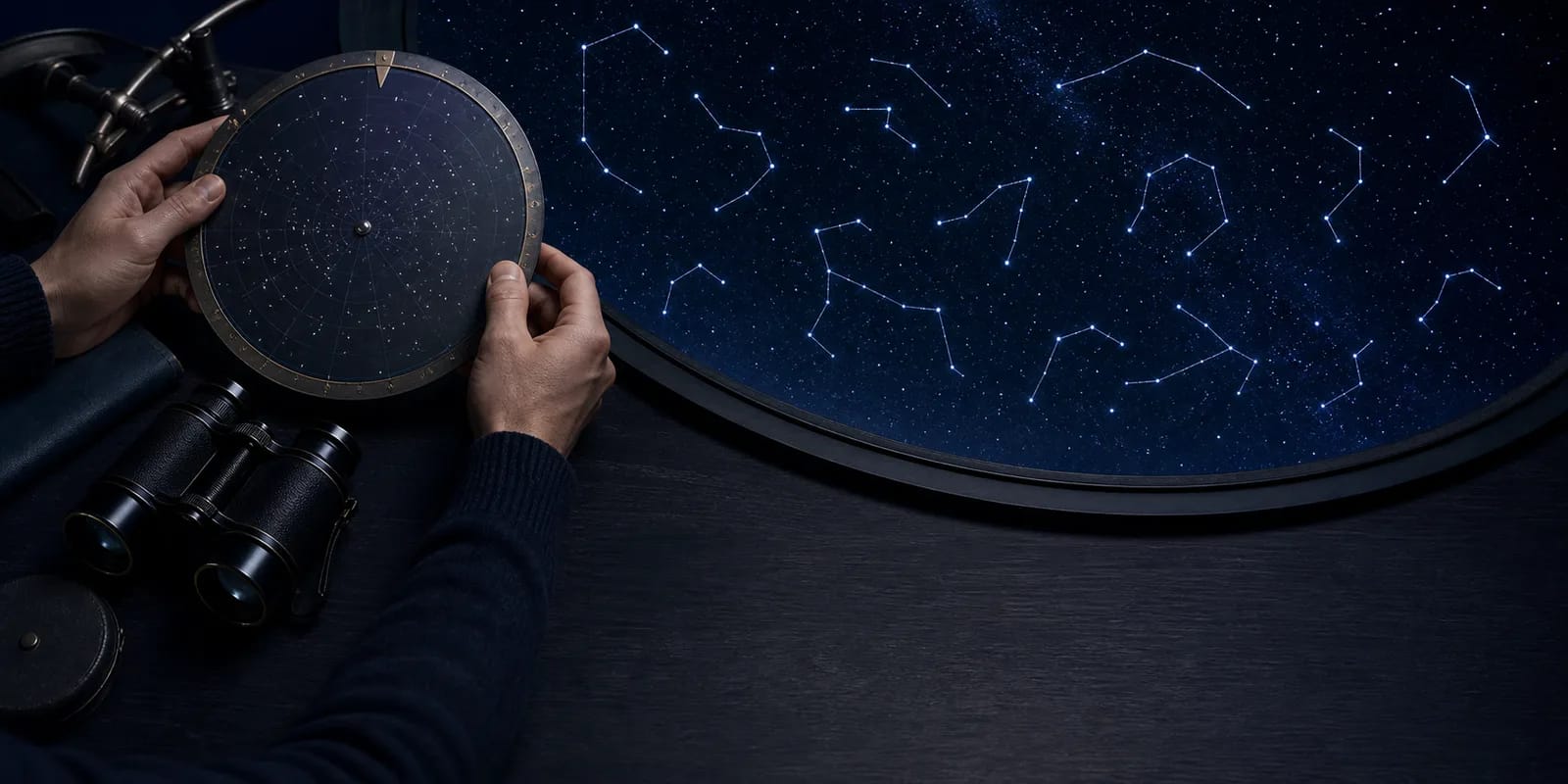
The line figures are not fixed by nature. They were redrawn in manuscripts, globes, and printed atlases over centuries. Our history of star maps explains how those visual conventions changed as celestial charts developed.
Here are the stories behind eight of the most famous constellations in the sky.
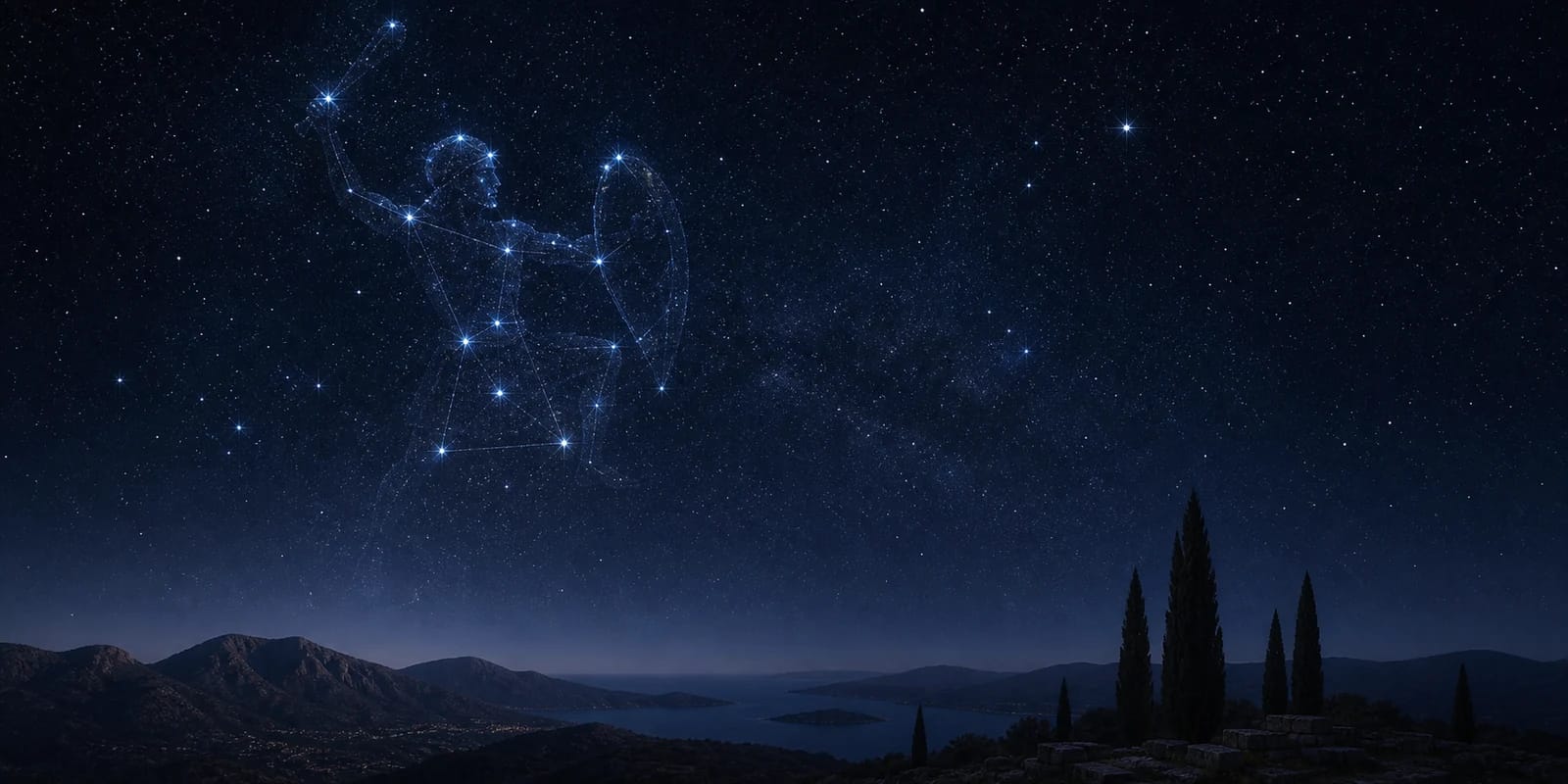
Orion -- The Hunter Who Challenged the Gods
Orion is easy to recognize by its three-star belt, flanked in the familiar line figure by the red supergiant Betelgeuse near one shoulder and blue-white Rigel near one foot.
In Greek mythology, Orion was a giant hunter who boasted he could kill every animal on Earth. Gaia, goddess of the Earth, sent a giant scorpion to stop him -- and the scorpion succeeded. Zeus placed both Orion and his killer in the sky on opposite sides, so they would never face each other again.
How to find it: Look for three aligned stars in the southern sky -- the belt is unmistakable. Best visible: December through March, dominating winter evenings.
Ursa Major -- The Bear and the Betrayed Nymph
Ursa Major contains the Big Dipper, a widely recognized Northern Hemisphere asterism. Its Greek myth is one of jealousy and transformation.
Callisto, a nymph devoted to Artemis, caught the eye of Zeus. They had a son, Arcas. When Hera discovered the affair, she transformed Callisto into a bear. Years later, Arcas nearly killed his own mother while hunting. Zeus intervened, sweeping both into the sky as Ursa Major and Ursa Minor. One version adds that Hera asked the sea gods never to let the bears enter the ocean. Astronomically, the figures are circumpolar only from sufficiently northern latitudes.
How to find it: The Big Dipper's seven bright stars are hard to miss. The two end-stars of the bowl point toward Polaris. Best visible: Year-round, highest during spring evenings.
Cassiopeia -- The Queen Who Paid for Her Vanity
Five bright stars forming a distinctive W near the North Pole -- that is Cassiopeia. Her story is one of pride and punishment.
Queen Cassiopeia boasted that she and her daughter Andromeda were more beautiful than the Nereids, Poseidon's beloved sea nymphs. The enraged god sent the monster Cetus to ravage the coast. The only remedy was sacrificing Andromeda by chaining her to a rock. As punishment, Cassiopeia was placed on a throne that rotates around the celestial pole. Half the night she hangs upside down -- a humiliating fate for a vain queen.
How to find it: Look for the W-shape opposite Polaris from the Big Dipper. Best visible: Year-round, highest during autumn evenings.
Leo -- The Nemean Lion
Leo represents the Nemean Lion, whose golden fur was impervious to any weapon. Killing it was the first of Heracles's twelve labors.
Arrows, swords, and clubs all bounced off the lion's hide, so Heracles wrestled and strangled the beast bare-handed. He used its own claws to skin it and wore the pelt as armor. Zeus placed the lion among the stars. Its brightest star, Regulus, means "little king" in Latin. To learn more about Leo and the zodiac, see our zodiac constellations guide.
How to find it: Look for the backward question mark (the Sickle) forming the lion's head. Best visible: March through May on spring evenings.
Cygnus -- The Swan and the Disguise of a God
Cygnus spreads its wings across the summer Milky Way. Its brightest star, Deneb, forms one corner of the Summer Triangle with Vega and Altair.
Zeus disguised himself as a swan to approach Leda, Queen of Sparta. From their union came Helen of Troy, whose beauty triggered the Trojan War. Another version connects Cygnus to Orpheus, the musician transformed into a swan after death and placed beside his lyre in the sky. The constellation genuinely resembles a bird in flight, and the Northern Cross asterism formed by its brightest stars is one of the most elegant shapes overhead.
How to find it: Find Deneb as part of the Summer Triangle -- three bright stars dominating the sky. Best visible: June through October, overhead on summer evenings.
Scorpius -- The Scorpion That Killed a God
Scorpius has a curving line of stars often read as a body and tail, with a hook near the end. Antares, a red supergiant, marks its central region; its traditional name is commonly interpreted as “rival of Mars.”
The scorpion's story is inseparable from Orion's. Gaia sent Scorpius to humble the boastful hunter, and both perished. The story places them on opposite sides of the sky: when Scorpius is prominent, Orion is generally absent from the evening view. Their exact visibility still depends on latitude, season, and time. For more on Scorpius, explore our zodiac constellations guide.
How to find it: Look low in the southern sky for the J-shaped curve. Antares glows red at the center. Best visible: June through August on summer nights.
Andromeda -- The Princess Chained to the Stars
Andromeda's story connects four constellations in a single drama: Cassiopeia, Cepheus, Andromeda, and Perseus.
After Cassiopeia's boast, Poseidon demanded Andromeda be chained to a coastal rock as sacrifice to Cetus. Perseus, fresh from slaying Medusa, spotted the princess from above, fell in love, and struck a deal with her parents. He turned Cetus to stone with Medusa's severed head and freed Andromeda. All the players were placed together in the sky. The constellation also hosts the Andromeda Galaxy (M31), visible to the naked eye on clear nights as a faint smudge of light.
How to find it: Start from the Great Square of Pegasus and follow stars extending from its upper-left corner. Best visible: September through January on autumn evenings.
Canis Major -- The Faithful Hound and the Brightest Star
Canis Major follows Orion across the sky and contains Sirius, the brightest star in Earth's night sky.
In one Greek tradition, the Great Dog is identified as Laelaps, a magical hound that never failed to catch its prey. When set to chase the uncatchable Teumessian fox, Zeus resolved the paradox by turning both to stone and placing the dog among the stars. If you are new to finding these patterns, our astronomy for beginners guide will help you get started.
How to find it: Follow Orion's belt downward and to the left -- Sirius outshines everything. Best visible: December through March, trailing Orion across winter skies.
How Constellation Stories Appear on a Star Map
OwnStarMap can add conventional line segments and labels to its fixed catalogue stars. A figure appears only where its relevant stars survive the ideal-horizon and design-shape filters. The line convention is a reading aid, not an official boundary and not a guarantee that every named constellation will fit one poster.
The International Astronomical Union's constellation guide distinguishes the 88 standardized sky regions from the many line figures used by different atlases. OwnStarMap documents its own implementation and limits on the public method page.
Create a free preview, switch the line layer on and off, and use the labels as an invitation to explore the stories rather than as a substitute for an observing atlas.
The Sky as a Storybook
The next time you look up on a clear night, remember that you are seeing the same characters that ancient Greeks, Egyptians, and Babylonians saw. The hunter is still chasing his prey. The queen is still paying for her vanity. The faithful dog is still following its master across the sky.
These stories have survived thousands of years because they speak to something universal: our need to find meaning in the vastness above us. A constellation is not just a pattern of light -- it is a story connecting us to every generation that has ever looked up and wondered.
Design your star map now -- and make the night sky part of your own story.
Ready to capture your special moment?
Create a personalized star map in minutes.
Design my Star Map — from 12,00 €