Orion at a Glance
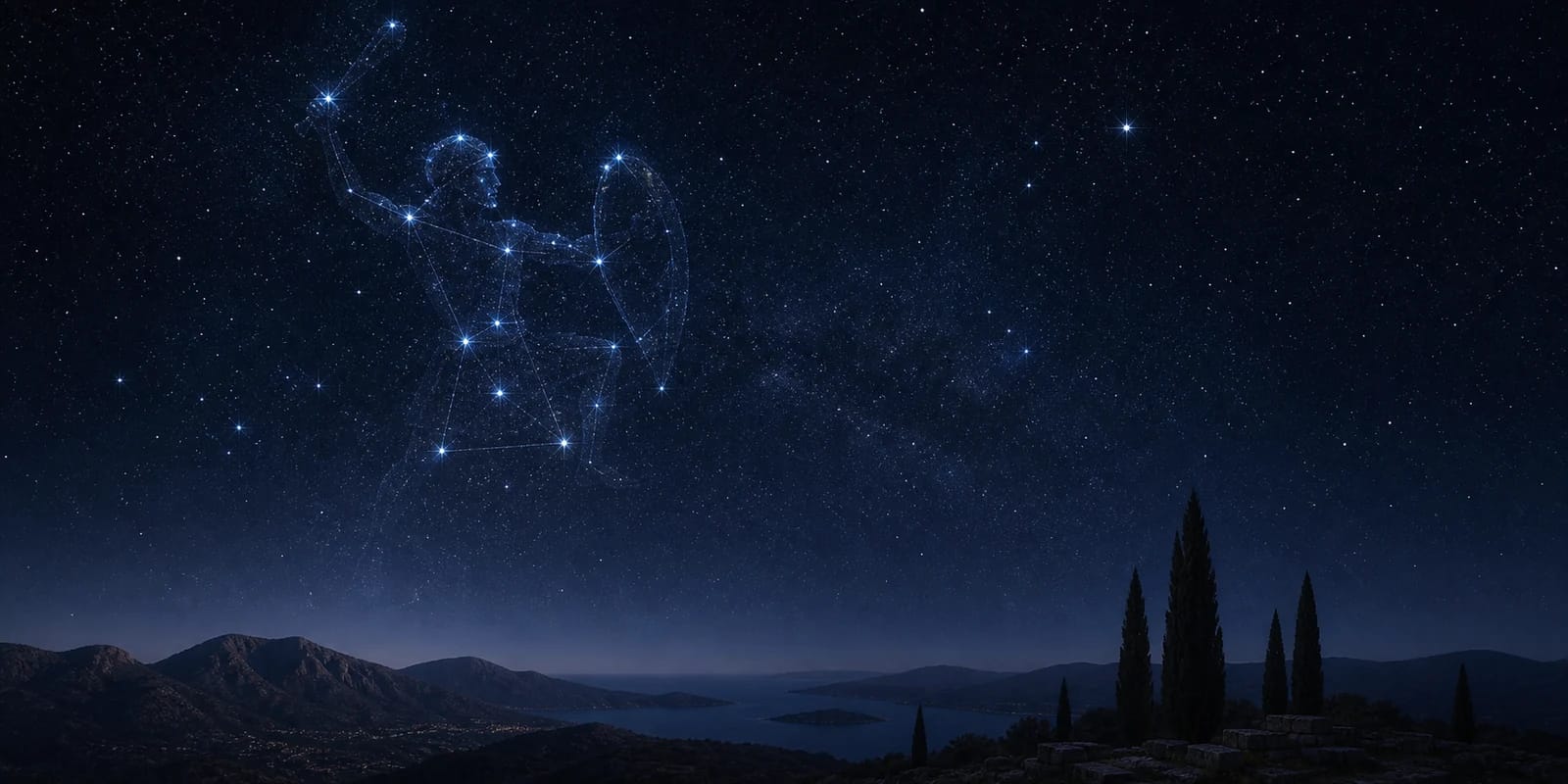
If you learn only one constellation in your life, make it this one. Orion commands the winter sky with a grandeur that four thousand years of stargazing have not diminished. Even from a city drenched in artificial light, its stars cut through the orange haze of light pollution.
Key Facts:
| Data | Value |
|---|---|
| IAU abbreviation | Ori |
| Area | 594 square degrees (26th largest) |
| Brightest star | Rigel (magnitude 0.13) |
| Main stars | 7 |
| Best visibility | December to March |
| Hemisphere | Visible from both |
| Right ascension | 5h |
| Declination | +5° |
Why is Orion THE most recognisable constellation in the world? Because it has everything: first-magnitude stars, a striking geometric alignment (the Belt), a deep-sky object visible to the naked eye (the M42 nebula), and a mythology that resonates across every culture. It straddles the celestial equator, making it observable from virtually anywhere on Earth. A shepherd in the Sahel, a fisherman in Hokkaido, and a hiker in Patagonia all see the same hunter rising into the night.
The Stars of Orion
Orion harbours some of the most spectacular stars in the sky. Each tells a different physical story -- from dying giants to multiple-star systems of staggering complexity.
Betelgeuse (Alpha Orionis)
The hunter's left shoulder glows with an unmistakable reddish-orange hue. Betelgeuse is a red supergiant whose diameter stretches to roughly 1,000 times that of the Sun. If placed at the centre of our solar system, its surface would engulf Jupiter's orbit. It lies approximately 700 light-years from Earth.
Betelgeuse is a semi-regular variable star: its brightness fluctuates over cycles of several hundred days. But between October 2019 and February 2020, it underwent a dramatic dimming -- its magnitude dropped from 0.5 to 1.6, unprecedented in modern observation. The world held its breath: was the long-awaited supernova imminent? It was not. Astronomers determined that a dust cloud, ejected by a coronal mass eruption on the star's surface, had temporarily obscured its light. The supernova will come, but probably not for another 100,000 years. When it does, Betelgeuse will shine as brightly as the full Moon for several weeks -- visible in broad daylight.
Its name comes from the Arabic يد الجوزاء (yad al-jawza'), meaning "the hand of the central one." Medieval transliteration mangled it into "Betelgeuse," and the name stuck.
Rigel (Beta Orionis)
The hunter's right foot is a blue-white furnace of staggering power. Rigel is a supergiant of spectral type B8, roughly 120,000 times more luminous than the Sun. At approximately 860 light-years away, it is the 7th brightest star in the night sky (apparent magnitude 0.13). If it stood at Sirius's distance (8.6 light-years), it would outshine everything else in the firmament like a second Moon.
The contrast with Betelgeuse is breathtaking: one is red and dying, the other blue and in the prime of its stellar life. To observe Orion is to witness two opposing cosmic destinies in a single glance.
Its name comes from the Arabic رجل (rijl), meaning "the foot."
The Belt of Orion: Alnitak, Alnilam, Mintaka
Three stars in near-perfect alignment, almost equally spaced and of comparable brightness. It is the most famous asterism in the sky after the Big Dipper. Yet this visual harmony is an illusion of perspective: the three stars lie at vastly different distances.
- Alnitak (Zeta Orionis): at roughly 1,200 light-years, it is a triple star system whose primary is a blue supergiant at magnitude 1.7. Its name means "the belt" in Arabic.
- Alnilam (Epsilon Orionis): the most distant of the three at roughly 1,300 light-years, and also the brightest (magnitude 1.7). A blue supergiant 275,000 times more luminous than the Sun. Its Arabic name means "the string of pearls."
- Mintaka (Delta Orionis): the nearest at roughly 900 light-years. A multiple star system. Its name means "the belt" or "the baldric."
The Belt is a superb tool for celestial navigation. Extend it down and to the left: you land on Sirius, the brightest star in the sky. Extend it up and to the right: you reach Aldebaran, the red eye of Taurus. Three stars are enough to map a large swath of the winter sky.
Bellatrix and Saiph
Bellatrix (Gamma Orionis), the right shoulder, is a blue giant about 250 light-years away. Its Latin name means "the female warrior." Saiph (Kappa Orionis), the left foot, is a blue supergiant roughly 650 light-years distant. Its name comes from the Arabic سيف (sayf), meaning "the sword." Together, Bellatrix and Saiph complete the rectangle that gives the hunter his imposing silhouette.
Summary Table
| Name | Designation | Magnitude | Distance (ly) | Spectral type | Name meaning |
|---|---|---|---|---|---|
| Rigel | Beta Ori | 0.13 | ~860 | B8 Ia | "The foot" (Arabic) |
| Betelgeuse | Alpha Ori | 0.42 (var.) | ~700 | M1-M2 Ia | "The hand of the central one" (Arabic) |
| Bellatrix | Gamma Ori | 1.64 | ~250 | B2 III | "The female warrior" (Latin) |
| Alnilam | Epsilon Ori | 1.69 | ~1,300 | B0 Ia | "The string of pearls" (Arabic) |
| Alnitak | Zeta Ori | 1.77 | ~1,200 | O9.5 Ib | "The belt" (Arabic) |
| Saiph | Kappa Ori | 2.09 | ~650 | B0.5 Ia | "The sword" (Arabic) |
| Mintaka | Delta Ori | 2.23 | ~900 | O9.5 II | "The baldric" (Arabic) |
The Orion Nebula (M42)
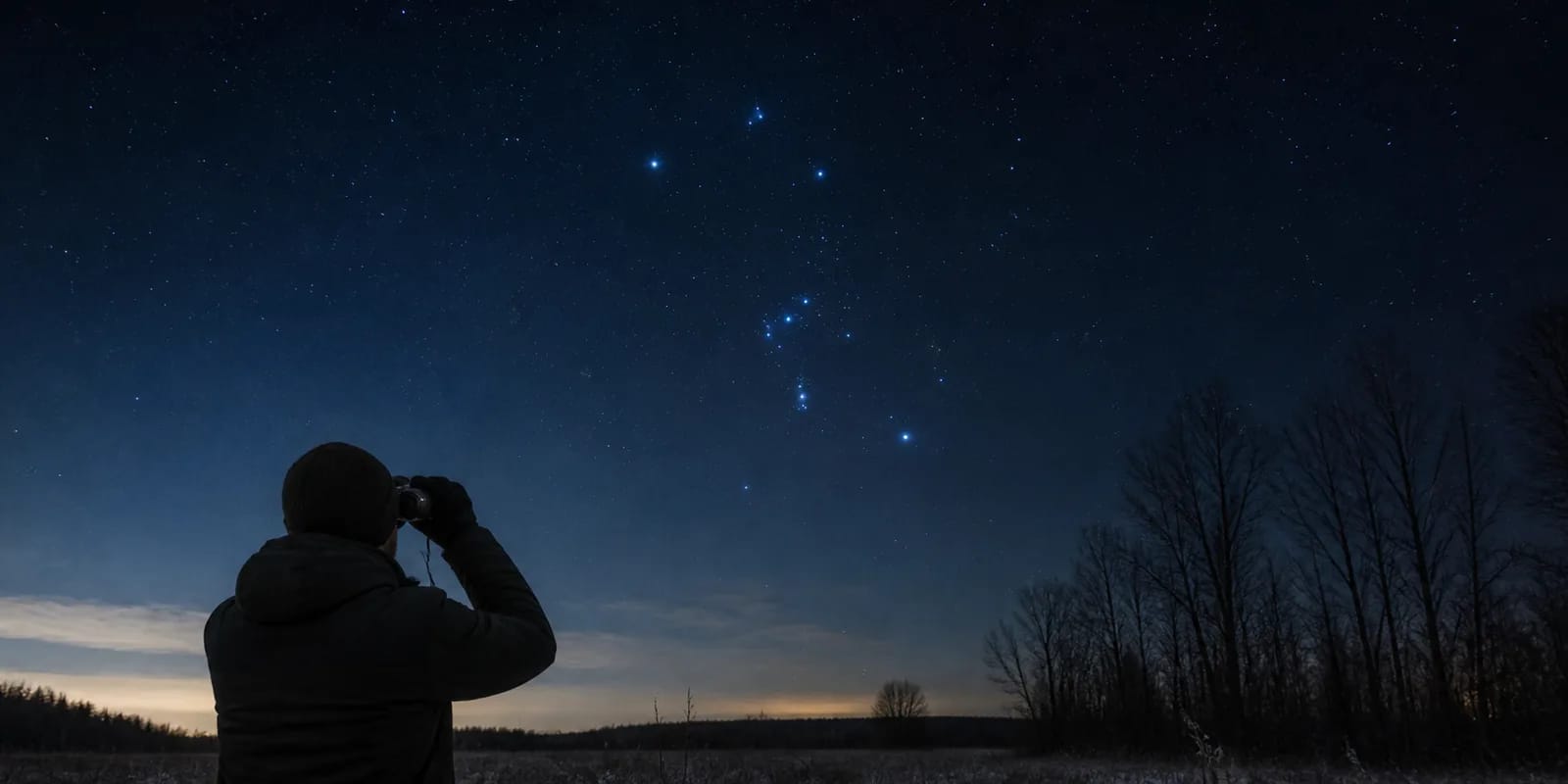
Just below the Belt, in what astronomers call the "Sword of Orion," hides one of the most extraordinary objects in the sky: the Orion Nebula, or M42. To the naked eye, it appears as a faint, milky smudge. With binoculars, it reveals swirling tendrils of gas with complex contours. Through an amateur telescope, it becomes a breathtaking spectacle -- curtains of light sculpted by the ultraviolet radiation of young stars.
M42 is a stellar nursery. At roughly 1,350 light-years away, within a cloud of gas and dust spanning about 24 light-years across, new stars are being born right now. At the nebula's heart, the Trapezium -- a cluster of four massive young stars -- illuminates the surrounding gas and carves structures of pillars and cavities.
It is one of the most photographed deep-sky objects, and for good reason: its surface brightness is high enough to be captured by a simple camera on a tripod with an exposure of just a few seconds. For a beginner, it is the perfect gateway to deep-sky observation.
How to Find Orion in the Sky
Northern hemisphere, winter evenings (December to March): Look south between 9 PM and midnight. The Belt -- three stars in a line -- is your starting point. Once you spot it, everything falls into place: Betelgeuse glows red at the upper left, Rigel shines blue-white at the lower right, and the nebula glimmers faintly beneath the Belt.
Using Orion as a celestial road map:
- Down and to the left: extend the Belt to find Sirius (Alpha Canis Majoris), the brightest star in the night sky. Impossible to miss.
- Up and to the right: extend the Belt to reach Aldebaran (Alpha Tauri), the red eye of Taurus, and beyond it, the Pleiades cluster.
- The shoulders point to Gemini: Betelgeuse and Bellatrix indicate the direction of Castor and Pollux.
- Below the feet: Rigel points toward Canopus (Alpha Carinae), the second brightest star in the sky, visible from southern latitudes.
Orion is the crossroads of the winter sky. Once you know it, you know half the winter firmament.
The Mythology of Orion
The Giant Hunter of Greek Mythology
Orion was a giant born from the Earth itself, or a son of Poseidon in other accounts. A hunter of prodigious skill, he boasted one day that he could slay every beast on Earth. This arrogance angered Gaia, goddess of the Earth and protector of all creatures. She sent a giant scorpion to punish him. The battle was fatal for both: Orion succumbed to the venom, and the scorpion was crushed.
Zeus, impressed by the hunter's bravery, placed Orion among the stars. But as a precaution, he also placed the Scorpion -- on the opposite side of the sky. Their seasons largely alternate for observers at many northern latitudes: as Scorpius becomes prominent in summer evenings, Orion belongs to the winter sky. That striking seasonal contrast has fascinated observers for millennia.
Beyond Greece: Orion Across Cultures
The constellation has inspired independent stories across the world:
- Ancient Egypt: the Belt of Orion was associated with Osiris, god of the dead and rebirth. Robert Bauval's theory (1994) proposes that the three pyramids of Giza are aligned with the three Belt stars, mirroring their relative positions in the sky. Controversial but fascinating, the hypothesis continues to fuel passionate debate.
- Aboriginal Australian tradition: for some Aboriginal peoples, the three Belt stars represent three brothers who went fishing in a canoe. Punished for catching a sacred fish, they were placed in the sky for eternity.
- Maori tradition: in New Zealand, Orion is known as Tautoru (the three). The Belt announced the beginning of the harvest season.
- Chinese tradition: the Orion region contained several distinct asterisms in the Chinese system. The three Belt stars formed Shen, one of the 28 lunar mansions, associated with trade and travel.
The fact that civilisations separated by oceans and millennia all independently noticed and named the same three aligned stars speaks to the sheer visual power of this constellation.
Orion on Your Star Map
Orion dominates winter star maps. Because the constellation straddles the celestial equator (declination around +5 degrees), it is visible from almost everywhere on Earth -- from the highest northern latitudes to the far reaches of the southern hemisphere (where it appears "upside down").
Picture a star map of December 25th in Paris: Orion reigns high in the southern sky, Betelgeuse blazes red, Rigel answers in blue, and the M42 Nebula shimmers below the Belt. This is the kind of sky that turns a Christmas gift into an unforgettable keepsake.
If you are planning a winter wedding, a December birthday, or marking a January birth, Orion will be there on your map. Turn on constellation lines in the OwnStarMap design tool and find the hunter exactly where he stood that night.
Create your winter star map with Orion
Frequently Asked Questions
When can you see Orion?
In the northern hemisphere, Orion is visible from November to March. It appears in the east during early evening around November, culminates due south around January, and disappears in the west by March. During summer months, it is above the horizon only during daytime -- invisible.
Is Betelgeuse about to explode?
Someday, yes. Betelgeuse will end its life as a supernova -- that is a physical certainty. But "soon" in astronomical terms means within the next 100,000 years, making the event extremely unlikely in our lifetimes. If it happened, the supernova would be visible in broad daylight for several weeks and shine at night like a small Moon. At 700 light-years away, there is no danger to Earth.
Why is the Belt of Orion so famous?
Because it is a unique alignment in the sky: three stars of comparable brightness, nearly equally spaced, forming an almost perfect straight line. No other asterism offers this combination of geometric regularity and luminosity. It is a universal landmark, recognised independently by every civilisation that ever watched the sky.
Can you see Orion from the southern hemisphere?
Absolutely. Orion is visible from both hemispheres. From the southern hemisphere, the constellation appears inverted: the Belt remains at centre, but Rigel ends up on top and Betelgeuse at the bottom. The hunter seems to walk upside down -- a fact that already amused European navigators in the 16th century.
Are the pyramids really aligned with Orion?
The Orion Correlation Theory, proposed by Robert Bauval in 1994, suggests that the three Giza pyramids replicate the alignment of the three Belt stars. The idea is seductive and visually compelling. However, the Egyptological community remains deeply divided: critics point out that the alignment is approximate, the orientation is mirrored, and the theory requires cherry-picking data. Controversial but undeniably fascinating, it continues to captivate the public and researchers alike.
Orion is far more than a luminous pattern in the winter sky. It is an open-air astrophysics laboratory, a mythological monument visible from the entire planet, and the finest astronomy teacher for anyone looking up for the first time. Whether you are an amateur astronomer or a casual dreamer, the hunter awaits you every winter, unchanging and faithful, exactly where the Greeks, Egyptians, and Aboriginal Australians always saw him.
Find Orion on your personalised star map -- and hang the eternal hunter on your wall.
Ready to capture your special moment?
Create a personalized star map in minutes.
Design my Star Map — from 12,00 €