Have You Ever Wondered?
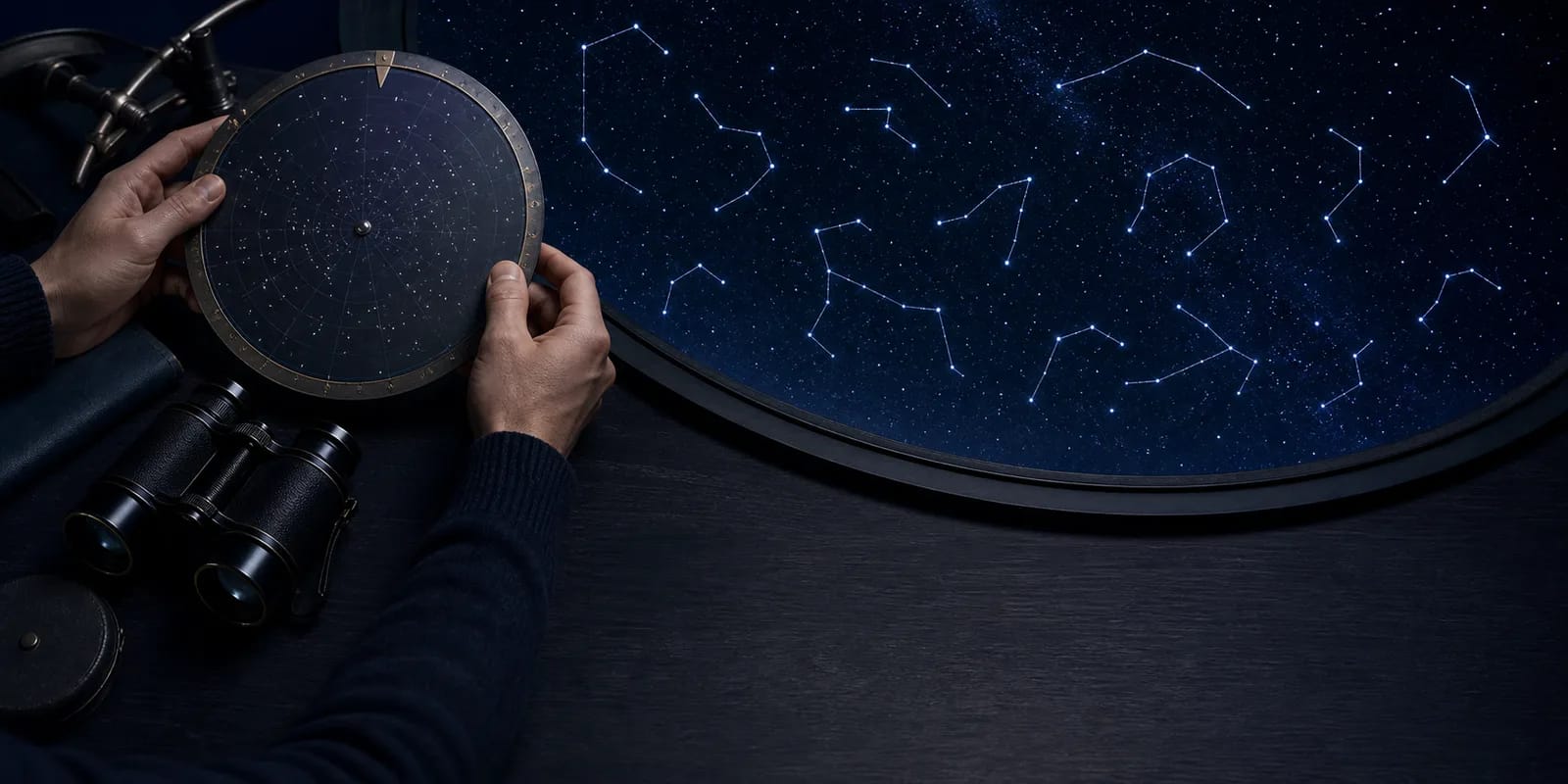
Have you ever looked up at the sky and wondered which stars were above your birthplace when you were born? The answer depends on the date, local time, location and the astronomical model used. A planetarium can help you investigate that sky; a personalized poster turns selected parts of it into commemorative wall art. Those are related uses, but they do not make the poster a complete observing record.
Your Birth Sky Is Unique
Why can two birth skies look different? Several astronomical factors combine to change an observer's view.
Earth's rotation sweeps stars from east to west throughout the night. Over the course of a single evening, the sky changes dramatically — the constellations visible at 9 PM are not the same ones you see at 3 AM. Earth rotates roughly 15 degrees per hour, meaning even a one-hour difference in your birth time shifts the visible sky noticeably.
Earth's orbit around the Sun changes the visible constellations season by season. A baby born in Chicago in January sees Orion high overhead, with Sirius blazing in the south. A baby born in July sees the Summer Triangle — Vega, Deneb, and Altair — dominating the heavens instead.
Your latitude and longitude determine which stars sit above the horizon. From New York, you never see the Southern Cross. From Sydney, you never see Polaris. Your birthplace literally defines which half of the sky was available to you.
Even within the United States, latitude makes a real difference. A birth in Miami (26°N) brings bright southern stars like Canopus within reach of the horizon, while a birth in Seattle (47°N) or Anchorage (61°N) tilts the sky toward circumpolar constellations such as the Big Dipper and Cassiopeia, which never set at those latitudes. Two babies born the same night on opposite coasts — say, Boston and San Diego, roughly 2,600 miles apart — would each have a measurably different sky overhead.
Time of day matters as well. If you were born during daylight, the stars were still there — simply hidden behind the Sun's glare. Your birth sky existed whether you could see it or not.
Which Constellations Were Visible?
The International Astronomical Union (IAU) officially recognizes 88 constellations covering the entire celestial sphere. At any given moment, roughly half of them are visible from a specific point on Earth. Here is a seasonal guide for the Northern Hemisphere.
Winter Sky (December - February)
Winter offers the most spectacular sky of the year. Orion, the hunter, dominates with three aligned stars forming his belt. At his shoulder, Betelgeuse glows deep red, while Rigel lights up his foot with intense blue. Nearby, Taurus features the brilliant Aldebaran and the Pleiades star cluster. Gemini (Castor and Pollux) and Canis Major with Sirius — the brightest star in the entire night sky — complete this stunning winter tableau.
Spring Sky (March - May)
Spring brings Leo with Regulus, Virgo with Spica, and Bootes with the brilliant Arcturus — the fourth brightest star in the sky. This is also the season when distant galaxies come into view, as the spring sky faces away from the plane of our Milky Way.
Summer Sky (June - August)
Summer is dominated by the Summer Triangle: Vega in Lyra, Deneb in Cygnus, and Altair in Aquila. Scorpius crawls near the southern horizon with the reddish Antares, while Sagittarius points toward the center of our galaxy. The Milky Way reaches its visual peak during summer nights.
Autumn Sky (September - November)
Autumn reveals the Great Square of Pegasus, the Andromeda Galaxy (the most distant object visible to the naked eye), and the recognizable W of Cassiopeia. It is a quieter sky, but one that holds treasures for those who know where to look.
An Important Note
These descriptions apply to the Northern Hemisphere. If you were born in the Southern Hemisphere — in Buenos Aires, Cape Town, or Melbourne — your sky was radically different, featuring constellations like the Southern Cross, Centaurus, and Carina.
Also worth noting: your astrological zodiac sign does not necessarily match the astronomical constellation that was behind the Sun on your birthday. Astrological dates are shifted by roughly one month from actual positions due to the precession of the equinoxes. Astronomy gives you the real sky.
How to Investigate Your Birth Sky
A useful reconstruction starts with a documented local date, time, time zone and location. If the time is uncertain, compare several plausible hours rather than presenting one invented time as fact.
Sidereal time relates the civil timestamp to Earth's rotation relative to the stars. Different tools may use different time standards and corrections, so record the settings when comparing results.
Equatorial-to-horizontal conversion transforms catalogue right ascension and declination into altitude and azimuth for the chosen observer. A geometric horizon is not the same as a real view: terrain, buildings, weather, atmospheric refraction and light pollution can all change what someone actually sees.
Projection maps the sky dome onto a flat screen or poster. The projection and crop affect spacing and shape, while constellation segment lines are drawing conventions rather than official IAU boundaries.
OwnStarMap's bundled input is HYG-derived, but the precise upstream release was not preserved when it entered the project. The renderer also omits several effects and solar-system objects. The public method and evidence page records the current scope; use independently documented planetarium software when the goal is observation planning or scientific comparison.
The Brightest Stars of Your Night
Among the thousands of stars in your birth sky, some stand out for their brilliance. Here are the ten brightest stars visible from mid-latitudes, and when they rule the sky.
Sirius (Canis Major, magnitude -1.46) — The undisputed queen of the night sky, visible in winter. Arcturus (Bootes, magnitude -0.05) — Orange giant of spring and summer. Vega (Lyra, magnitude 0.03) — Blue-white jewel of the Summer Triangle. Capella (Auriga, magnitude 0.08) — Present nearly year-round from mid-latitudes. Rigel (Orion, magnitude 0.13) — Blue supergiant of winter. Procyon (Canis Minor, magnitude 0.34) — Winter companion to Sirius. Betelgeuse (Orion, magnitude ~0.42) — The variable red giant at Orion's shoulder. Altair (Aquila, magnitude 0.76) — Southern vertex of the Summer Triangle. Aldebaran (Taurus, magnitude 0.85) — The red eye of the bull in winter. Spica (Virgo, magnitude 0.97) — The celestial ear of wheat in spring.
If you were born between November and March, Sirius, Rigel, and Betelgeuse were almost certainly part of your sky. Born between June and September, Vega, Deneb, and Altair were watching over you.
Create Your Birth Star Map
You do not need to be an astronomer to create a keepsake around a birth date. OwnStarMap lets you enter a date, time, and location and preview a design; the public method page explains the renderer’s scope and limits.
Enter your birth date, time, and location, then choose a design and add an inscription such as “The stars above when you arrived.” Treat an approximate time as an approximation, not as a guarantee that the visual precisely matches an observed sky.
It can be a thoughtful birth gift — for a newborn, a growing child, or an adult reflecting on their first night. Check the live product and checkout information for the current preview, format, and fulfilment options.
FAQ
What stars were shining the day I was born?
A birth star map is a commemorative design built from a date, time, and place. The time and place you enter materially affect the result; see the public method page for the renderer's documented scope and limits.
Do I need to know the exact time I was born?
Use the documented birth time when it is available. Earth turns about 15 degrees per hour, so changing the time can noticeably rotate the local sky. If the time is unknown, compare several plausible hours and label the chosen time as an approximation rather than a recovered fact.
Is a birth star map scientifically accurate?
It is designed as commemorative wall art, not as a professional planetarium or astrometry tool. Review the public method page to see what the renderer calculates and what it does not model.
Does the sky on my birthday reveal anything about my personality?
No. A date-based sky design is not a horoscope, personality reading, prediction or compatibility score. Any emotional meaning comes from the person and event you associate with the date.
Is a birth star map a good gift?
It can be a thoughtful gift when the recipient values personal dates and wall art. You can add a message and choose a style; check the live product page and checkout for the formats and fulfilment options currently available.
How do I create the sky from my birth date if I know nothing about astronomy?
Enter a date, time and city, then inspect the preview. No astronomy knowledge is required to use the editor, but the public method page is available if you want to understand the catalogue, horizon filter, projection and limits. The duo editor can place two selected moments on one poster.
Can I see my birth sky if I was born during the day?
Stars remain in the sky during daylight even though scattered sunlight hides most of them from unaided view. A date-based map can still model its catalogue for that time, but it does not claim to reproduce everything an observer or instrument would have detected.
Ready to capture your special moment?
Create a personalized star map in minutes.
Design my Star Map — from 12,00 €