Your Wedding Night Was Written in the Stars
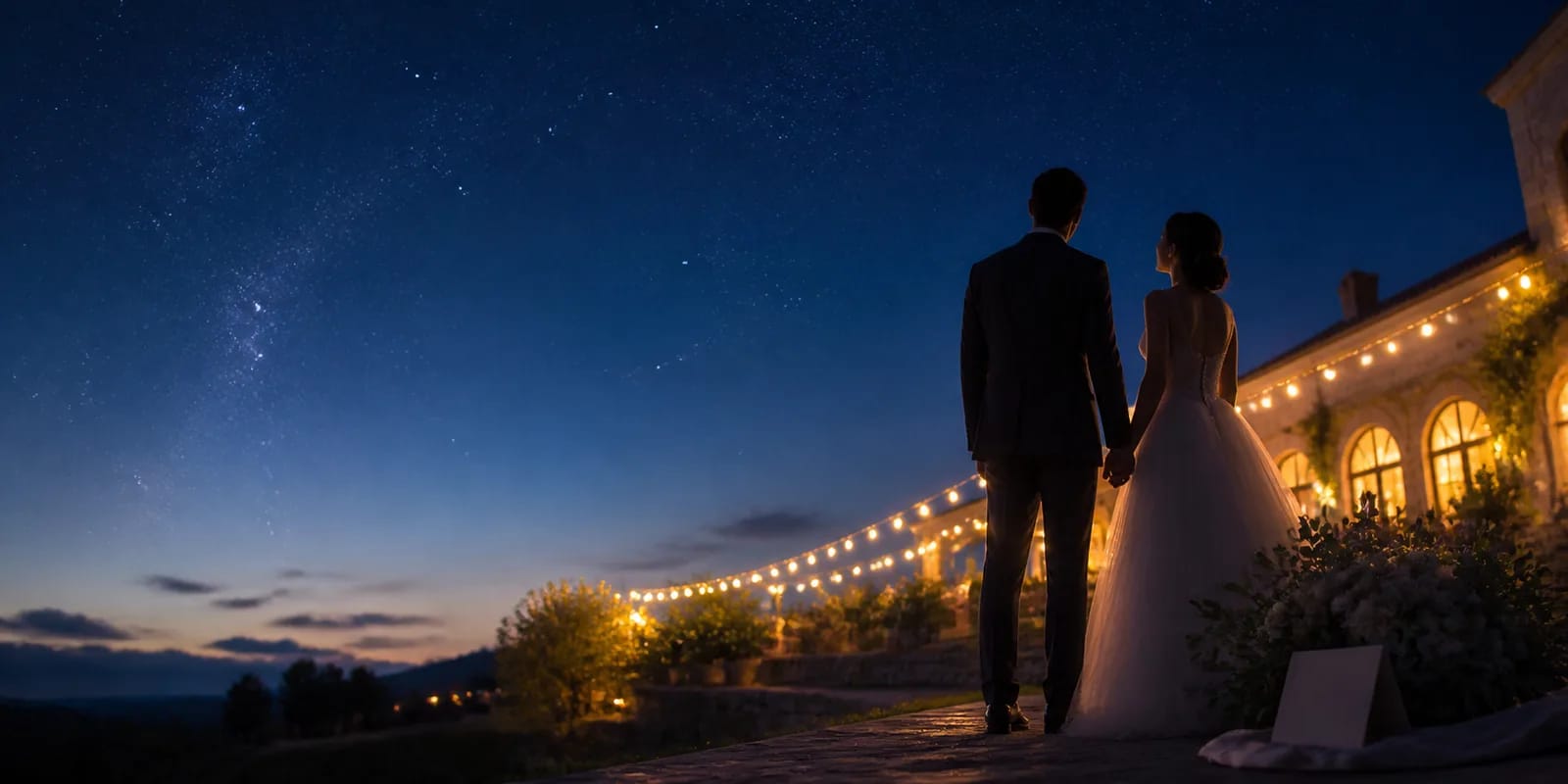
On the evening of your wedding, while you were dancing your first dance, cutting cake, and saying goodbye to guests who had traveled across the country to be there, the sky above you held a silent, spectacular show of its own. Thousands of stars, ancient constellations, and wandering planets arranged themselves into a pattern that belonged to your night and no one else's.
You probably did not look up. That is understandable. You had other things on your mind.
But the sky was there, marking the moment in its own way. And unlike the flowers that wilted by Monday or the champagne that ran out before midnight, those stars can be recovered. The exact sky from your wedding night can be reconstructed with scientific precision, star by star, constellation by constellation.
Why Every Wedding Sky Is One of a Kind
Two weddings are never under the same sky, even if they happen on the same date. The combination of time, location, and celestial mechanics guarantees that every wedding sky is genuinely unique.
The Date Sets the Stage
The constellations visible on a June wedding are completely different from those on a December wedding. A summer ceremony in the Northern Hemisphere unfolds beneath the Summer Triangle — Vega, Deneb, and Altair — with the luminous band of the Milky Way arching overhead. A winter wedding takes place under Orion, with Sirius blazing at magnitude -1.46, the brightest star in the sky.
Even weddings a single week apart show subtle shifts as Earth advances along its orbit, bringing new stars above the eastern horizon and letting others slip below the west.
The Venue Defines the View
A rooftop wedding in Manhattan and a vineyard ceremony in Tuscany on the same evening see different skies. New York sits at about 40 degrees north latitude. Florence sits at 43 degrees. That three-degree difference changes which stars graze the horizon and how high certain constellations climb. Move the wedding to Cape Town or Buenos Aires and the transformation is dramatic — the Southern Cross replaces the Big Dipper, and Canopus, invisible from most of Europe and North America, becomes the second brightest star in the sky.
The Hour Matters
A ceremony at golden hour, with the last sunlight streaming through the windows, corresponds to a sky just beginning to reveal its brightest stars. A reception that runs until midnight has rotated significantly — roughly 90 degrees of celestial motion since sunset. The sky above your first kiss and the sky above your last dance were measurably different.
How to Find Your Wedding Night Constellations
You do not need a telescope or an astronomy degree to discover what was overhead on your wedding night. You just need three pieces of information: the date, the approximate time, and the location of your venue.
Seasonal Signposts
Here is a quick guide to the constellations that likely graced your wedding night, based on season in the Northern Hemisphere.
Spring weddings (March to May) — Leo the lion sat high in the south, with Regulus marking its heart. The bright orange Arcturus in Bootes was rising in the east. Virgo with its blue-white star Spica completed the trio. This is an elegant, understated sky.
Summer weddings (June to August) — The Summer Triangle dominated the upper sky. Scorpius, with its fiery red heart Antares, hung low in the south. If your venue had dark skies, the Milky Way was a river of light crossing directly overhead.
Autumn weddings (September to November) — The Great Square of Pegasus was your celestial frame. Nearby, the Andromeda Galaxy was faintly visible to the naked eye, a smudge of light from 2.5 million light-years away. Cassiopeia's W pointed the way north.
Winter weddings (December to February) — Orion stood proud with his three-star belt, flanked by the Pleiades star cluster and the red eye of Taurus. Sirius flashed blue-white near the horizon. Winter holds the most brilliant collection of bright stars of any season.
For Southern Hemisphere weddings, the sky was different. The Southern Cross, Alpha Centauri (the closest star system to our Sun at 4.37 light-years), and the Magellanic Clouds were among your wedding guests.
Romantic Ways to Display Your Wedding Sky
A wedding sky is not just an astronomical curiosity. It is a piece of your love story, rendered in stars. Here are some ways couples preserve and display theirs.
Framed on the Wall
The most popular choice. A framed star map of your wedding night becomes a permanent fixture in your home — something you see every day without it demanding attention. Guests notice it, ask about it, and you get to tell the story again.
Paired with a Photo
Some couples place their wedding star map next to their favorite wedding photo. The juxtaposition — a candid moment from the reception alongside the cosmic view from the same evening — creates something unexpectedly moving.
With a Personal Inscription
A line of text beneath the star map anchors it to your story. It could be the date and venue, a lyric from your first dance song, or simply "the sky the night we said I do." The words do not need to be grand. The stars handle the grandeur.
As Part of a Gallery Wall
Mixed into a collection of prints and photographs, a star map adds depth and texture. It introduces an element that is simultaneously personal and universal — your night, but also the vast indifferent beauty of the cosmos.
The Perfect Anniversary Gift
If you are searching for a wedding anniversary gift that feels both thoughtful and original, the wedding night sky is hard to beat. It works for any anniversary year, whether your first or your fiftieth.
Why It Works
It requires no guesswork about taste or preference. You are not choosing a color, a scent, or a size. You are giving your partner a view of the sky from the most important night of your shared life. That is a gift rooted in fact, wrapped in meaning.
First Anniversary (Paper)
A printed star map is literally a paper gift, making it the ideal first anniversary present for couples who follow the traditional anniversary gift list.
Later Anniversaries
For a silver or golden anniversary, a framed star map becomes a retrospective — a way to look back across decades and remember the night it all began. It pairs beautifully with a handwritten note recalling a detail from the wedding day that only the two of you would know.
For Someone Else's Wedding
If you are attending a wedding and want to give a gift that stands apart from the registry, a star map of the wedding night is a striking choice. You only need the date and venue, both of which are on the invitation. No awkward questions, no risk of duplicates, and it arrives ready to frame and hang.
The night sky from your wedding is still out there, recorded in star catalogs and waiting to be brought back to life. Enter your wedding date and venue below to see it again.
Ready to capture your special moment?
Create a personalized star map in minutes.
Design my Star Map — from 12,00 €