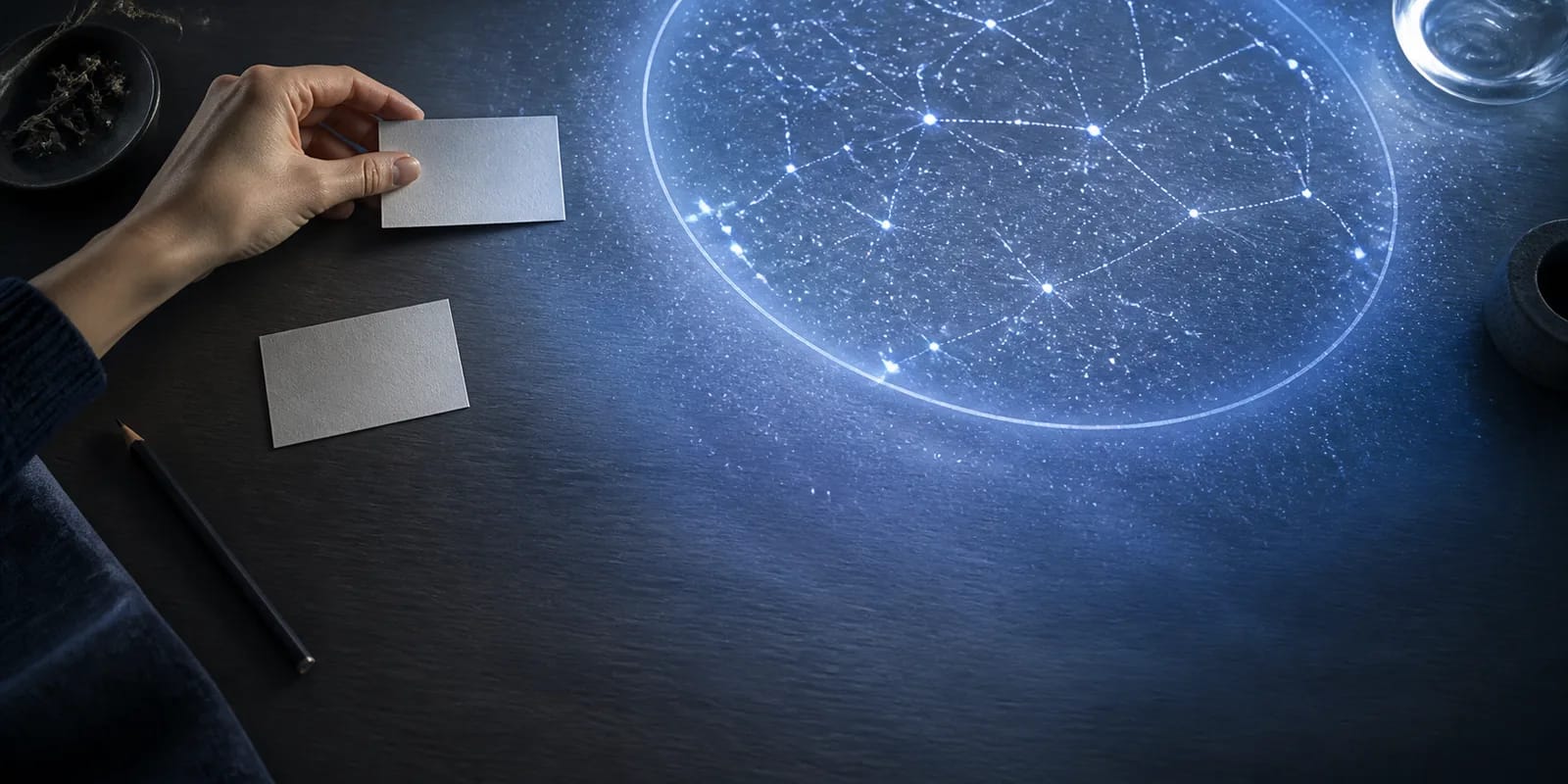
The Three Essentials
Creating a personalized star map requires three pieces of information:
- Date — The day of your special moment
- Time — The time of day (or night)
- Location — Where you were
That is it. Those three details define the context used by the design tool. The output is commemorative wall art, not a professional astronomical observation; read the public method page for the model’s documented scope and limits.
Let's go through each one and how to find them.
1. The Date
The date is usually the easiest piece to nail down. Most people create star maps for moments they remember clearly:
- A wedding date
- A birthday or birth date
- The day you met your partner
- A graduation date
- The day a loved one passed
For most of these, the exact date is either in your memory or easily verifiable.
How to find it if you are not sure:
- Check your calendar or planner from that year
- Look at social media posts or photo timestamps
- Ask family members or friends who were there
- Check official documents (marriage certificate, birth certificate)
The date affects which stars and constellations are visible. A summer sky looks completely different from a winter sky, so getting the right date matters.
2. The Time
The time determines the rotation of the sky — which stars are above the horizon and where exactly they are positioned. A difference of a few hours shifts the entire sky noticeably.
How Precise Does the Time Need to Be?
The sky changes gradually, not suddenly. Here is how precision affects the result:
- Within 15 minutes — Virtually identical to the "true" sky. Ideal accuracy.
- Within 1 hour — Very close. Most constellations are in the same position, with slight shifts at the horizon.
- Within 2-3 hours — Noticeable differences, especially near the horizon, but the overall composition is still representative.
- Approximate (morning/afternoon/evening) — The map will show a reasonable representation of the sky during that part of the day.
Our recommendation: get as close as you can, but do not stress about being exact to the minute. Even an approximate time produces a beautiful and meaningful map.
How to Find the Exact Time
For births:
- Birth certificates almost always include the time of birth
- Hospital records or baby books
- Ask the parents — most remember
For weddings:
- Check the invitation or order of service for ceremony time
- Look at photo timestamps (see the EXIF data trick below)
- The photographer's timeline or contract often specifies times
For first dates and meetings:
- Check text messages or chat history from that day — the timestamps reveal when you were making plans
- Look at restaurant or bar receipts
- Check ride-sharing app history (Uber, Lyft) for pickup times
- Social media check-ins
The EXIF data trick: Most smartphone photos contain hidden metadata including the exact date, time, and GPS location. Here is how to access it:
- iPhone: Open the photo, swipe up, and the date/time/location appear
- Android: Open the photo, tap the info icon (i) or check Details
- On a computer: Right-click the photo file, select Properties (Windows) or Get Info (Mac), and look for Date Taken
This is one of the most reliable ways to find the exact time of any event you photographed.
3. The Location
The location determines which part of the celestial sphere is visible. Someone in Paris and someone in Tokyo see different stars at the same moment.
How Precise Does the Location Need to Be?
Less precise than you might think:
- Same city — More than sufficient. Two locations 10 km apart in the same city produce virtually identical star maps.
- Same region — Very similar results. The differences are subtle and mostly affect stars near the horizon.
- Same country — Noticeable differences for large countries (France north vs. south), but the main constellations remain the same.
- Different continents — Significantly different skies. This is where precision matters most.
For most purposes, knowing the city is enough. You do not need the exact street address.
How to Find the Location
For events at a specific venue:
- Search the venue name on Google Maps
- Look up the address on the wedding invitation, birth announcement, or event details
- Check the venue's website
For births:
- The hospital name and city are usually well-known and documented
- Birth certificates include the city
For spontaneous moments:
- Check photo EXIF data (includes GPS coordinates)
- Look at Google Maps timeline if you had location history enabled
- Check social media check-ins or tagged locations
- Look at ride-sharing or food delivery app history for addresses from that day
For moments abroad:
- Check flight bookings or hotel reservations for the city
- Look at passport stamps for entry dates
- Check credit card statements for location clues
Does the Time Zone Matter?
Yes, but you usually do not need to worry about it. When you enter a location in our star map designer, we automatically determine the correct time zone — including historical daylight saving time rules. Just enter the local time as it was at that location, and the calculations handle the rest.
For example, if your wedding was at 4:00 PM in Paris on June 15, 2019, just enter 4:00 PM and Paris. We account for Central European Summer Time automatically.
What About the Inscription?
Beyond the three astronomical essentials, you will want to add a personal inscription — the text that appears on your star map and gives it meaning.
The inscription typically includes:
- A short phrase or sentence capturing the moment
- The date (formatted nicely)
- The location name
Some examples:
- "The night we met — September 12, 2020, Brooklyn"
- "Welcome to the world, little one — April 3, 2024, Lyon"
- "The stars above us when I said yes"
The inscription is what turns a sky chart into a personal keepsake. Take a moment to think about what you want to say. Our detailed guide on what to write on a star map can help with inspiration.
Tips for Surprising Someone
If the star map is a surprise gift and you need to find the date, time, or location without raising suspicion, here are some subtle strategies:
For a partner
- Casually bring up the memory in conversation: "Do you remember what time our wedding ceremony started?"
- Look through shared photo albums for timestamps
- Ask a mutual friend who was there
- Check your own messages or calendar from that period
For a parent (birth star map)
- Ask about the birth story — parents love telling it. They will often mention the time naturally.
- Check your birth certificate
- Ask a sibling to ask, so it does not seem suspicious
For a friend
- Bring up the shared memory and ask details: "What time did we get to that concert?"
- Check group chat history from around that date
- Look at social media posts from the event
The key is to be casual. Most people do not suspect that you are gathering information for a gift.
Ready to Create Your Star Map?
Now you have everything you need:
- Your date — the day it happened
- Your time — as close as you can get
- Your location — the city is enough
Head to our star map designer, enter your details, preview the design, and add your inscription. Before ordering, consult the public method page and the current checkout information for the available options.
The whole process takes about five minutes. The memory it captures lasts forever.
Ready to capture your special moment?
Create a personalized star map in minutes.
Design my Star Map — from 12,00 €