History remembers the facts. We found the stars.
When we tell the story of a historical event, we talk about dates, places and protagonists. We almost always forget one thing: the sky. Yet at every moment that changed the course of the world, stars were shining — or not shining — above the scene.
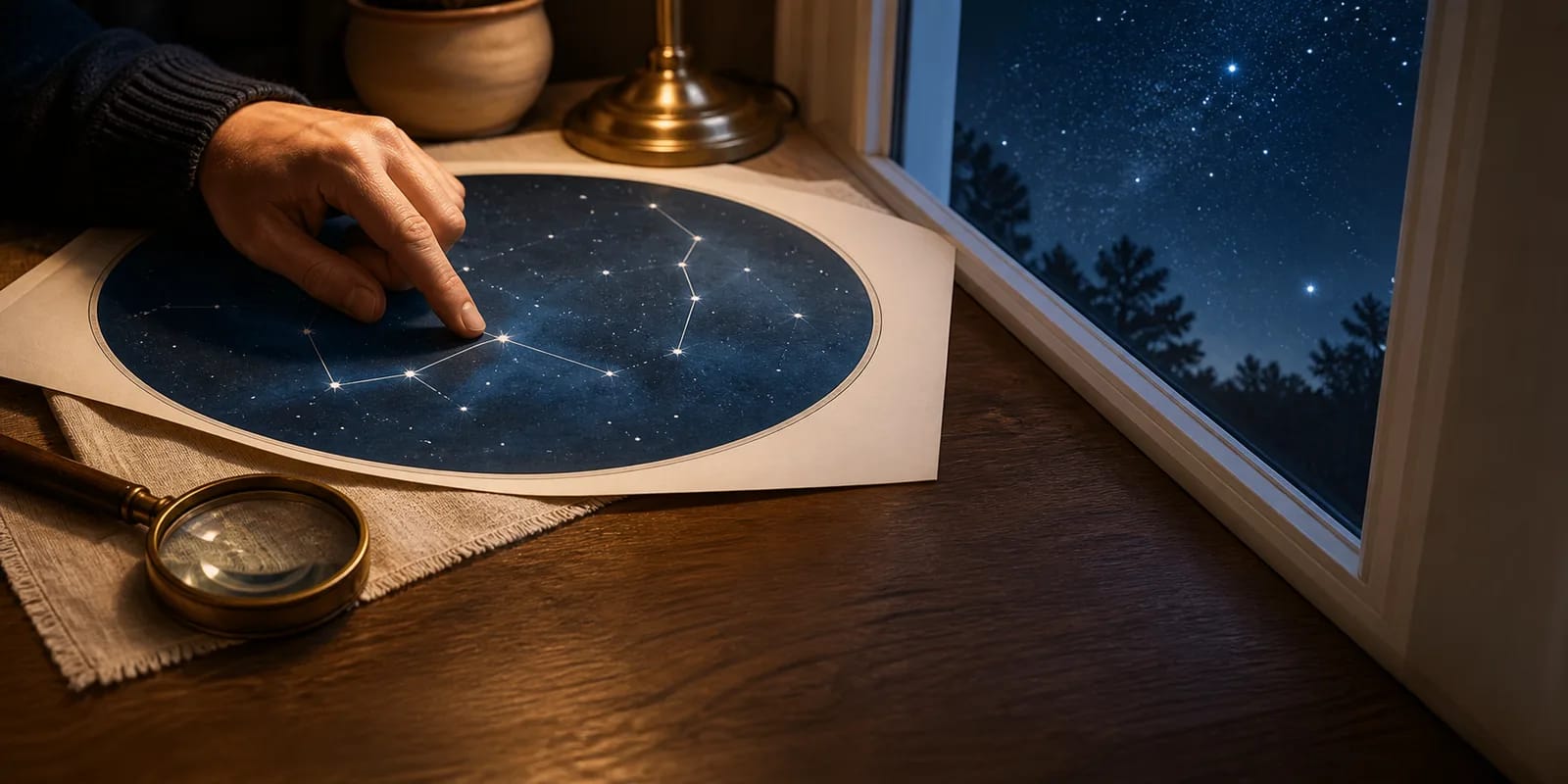
For each of the 10 moments below, we calculated the exact sky visible from the event's location, at the precise time it occurred, using the same astronomical algorithm that powers OwnStarMap: HYG v4.2 catalogue, IAU sidereal time, stereographic projection.
These aren't illustrations. These are the real skies of those nights.
1. First step on the Moon — 20 July 1969, 02:56 UTC
Location: Sea of Tranquility, Moon (0.67°N, 23.47°E) Event: Neil Armstrong places his left foot on the lunar surface
The first paradox of this historic night: from the Moon, the sky looks nothing like what we know on Earth. No atmosphere, no twinkling. Every star shines with a fixed, perfect light. The sky is jet black even during lunar daytime — the Sun and stars coexist in the same field of view.
But from Houston, Texas — where the world was listening — the summer sky displayed the Summer Triangle: Vega, Deneb and Altair dominated the zenith. Scorpius, with Antares at its heart, glowed in the south. Sagittarius pointed toward the centre of the Milky Way.
At 02:56 UTC (9:56 PM Houston time), the Texan sky was ideally positioned for summer observation. But nobody was looking at the stars that night — everyone was watching television.
2. Storming of the Bastille — 14 July 1789, around 5 PM
Location: Paris, France (48.85°N, 2.37°E) Event: The crowd storms the royal fortress
The assault on the Bastille took place in the afternoon. The starry sky wasn't visible. But as night fell — around 10 PM in July in Paris — the revolutionaries would have seen one of the finest summer skies.
The Summer Triangle was already high in the eastern sky. Vega, the brightest star of summer, was approaching the zenith. The Great Bear (Ursa Major) was visible to the northwest. And the Milky Way crossed the sky from south to northeast, a luminous arch above a city in revolution.
The Moon? Virtually new (day 0.5 of the lunar cycle). Paris was plunged into the darkest possible night — an astronomical coincidence that made the storming of the Bastille all the more dramatic.
3. The Armistice — 11 November 1918, 5:15 AM (signing) / 11 AM (ceasefire)
Location: Clearing of Rethondes, Compiegne, France (49.43°N, 2.89°E) Event: Signing of the World War I armistice
The armistice was signed at 5:15 AM in a railway carriage. At that hour in November at Compiegne, the Sun had not yet risen. The sky showed the winter constellations at their zenith: Orion — the hunter — dominated the south with his three-star belt. Sirius, the brightest star in the sky, twinkled to the southeast. Gemini was high above.
At 11 AM, when the ceasefire took effect and the guns fell silent for the first time in four years, the Sun was low on the southern horizon — a pale November sun through the Picardy mist.
The night sky of 10-11 November 1918 was exactly the same sky that soldiers in the trenches had contemplated for four years. The only difference: that night, they knew morning would bring silence.
4. D-Day — 6 June 1944, 1:30 AM
Location: Sainte-Mere-Eglise, Normandy, France (49.41°N, -1.32°W) Event: First paratroopers of the 82nd Airborne Division jump over Normandy
The choice of D-Day's date wasn't random — it was an astronomical decision. Eisenhower needed three conditions: (1) a low tide at dawn to expose German obstacles, (2) moonlight for glider pilots, and (3) tolerable wind. The window was narrow.
The Moon was indeed present that night — at first quarter, bathing the Norman countryside in enough silver light for paratroopers to see the ground approaching. But not bright enough for them to be easily spotted.
The 1:30 AM sky above Sainte-Mere-Eglise showed Leo in the southwest, Virgo in the south, and Ursa Major to the north — high and clearly visible. Polaris, as always, pointed north for the navigators.
For paratroopers dropped into darkness, the stars weren't a spectacle — they were navigation instruments.
5. Sinking of the Titanic — 15 April 1912, 2:20 AM
Location: North Atlantic (41°43'N, 49°56'W) Event: RMS Titanic sinks after striking an iceberg
This night is one of the most famous in history for its stargazing conditions. The Moon was absent (new moon on April 17). The ocean was dead calm — not a wave, not a breath of wind. And the sky over the North Atlantic, far from any light pollution, was exceptionally clear.
Survivors in the lifeboats described a sky of staggering beauty. Ursa Major was visible to the north. Leo dominated the south. The Milky Way, invisible in cities but brilliant over open ocean, stretched from horizon to horizon.
The cruel irony: it was precisely this moonless night and waveless ocean that made the iceberg nearly invisible. Moonlight or wave reflections would have revealed it sooner. Astronomy, that night, worked against the Titanic.
6. Gagarin in space — 12 April 1961, 9:07 AM (Moscow time)
Location: Baikonur Cosmodrome, Kazakhstan (45.62°N, 63.31°E) Event: Vostok 1 launches with Yuri Gagarin aboard
The launch took place in the morning — the night sky wasn't visible from Baikonur. But once Gagarin reached orbit, he saw something nobody had seen before: stars without atmosphere.
Without Earth's atmosphere to filter and scatter light, stars don't twinkle in space. They glow as fixed, perfectly stable points against absolute black. Gagarin described what he saw: "The sky is very dark. The Earth is blue."
From space, every star in the catalogue — far beyond the 9,096 visible to the naked eye on Earth — is theoretically visible. But Earth's own brightness, reflecting sunlight, creates enough glare to limit observation.
7. Fall of the Berlin Wall — 9 November 1989, around 11 PM
Location: Berlin, Germany (52.52°N, 13.40°E) Event: The first Berliners cross the border checkpoints
When the borders opened spontaneously on the night of November 9, the Berlin autumn sky showed the season's classic constellations. Pegasus — the winged horse — dominated the zenith. Andromeda, with its naked-eye galaxy, was high in the eastern sky. Cassiopeia's "W" shape shone to the north.
The Moon was waning (11th day of the cycle) and set around midnight, leaving the second half of the night to the stars. The Berliners dancing on the Wall could, had they looked up, have seen the same constellations on both sides — a sky that had never known a border.
8. Paris Olympics opening — 26 July 2024, 7:30 PM
Location: Seine, Paris, France (48.86°N, 2.35°E) Event: Opening ceremony on the River Seine
The opening ceremony of the Paris 2024 Olympic Games took place outdoors, on and around the Seine, under a late-July sky. At 7:30 PM, the Sun was still above the horizon (sunset around 9:40 PM in late July in Paris).
It was only after 10:30 PM, as the spectacle was in full swing, that the first stars appeared. The Summer Triangle — Vega, Deneb, Altair — was forming in the east. Arcturus in Bootes was glowing in the west. The Moon was in its last quarter and didn't rise until after midnight, leaving the ceremony sky to the stars alone.
Parisian light pollution limited visibility to a few hundred stars — but the brightest were there, above the boats and the athletes.
9. Napoleon's coronation — 2 December 1804
Location: Notre-Dame Cathedral, Paris (48.85°N, 2.35°E) Event: Napoleon crowns himself Emperor
The ceremony took place in the middle of the day. But the night before, above Notre-Dame, the winter sky offered its full splendour. Orion was rising in the east — the mythological hunter, symbol of strength and conquest. Sirius, the brightest of all stars, followed close behind.
Ursa Major, to the north, was low on the horizon in December. The Pleiades — the most famous star cluster in the sky — were near the zenith, a group of six to seven stars visible to the naked eye.
Napoleon, who had made the bee his symbol, probably didn't look at the sky the night before his coronation. But Orion was there, as it is every winter, unmoved by empires that rise and fall.
10. "I Have a Dream" — 28 August 1963, around 4 PM
Location: Lincoln Memorial, Washington D.C., USA (38.89°N, -77.05°W) Event: Martin Luther King delivers his speech
The speech was delivered on a radiant late-August afternoon. But that night, above the Lincoln Memorial, the American summer sky showed its most recognisable constellations.
The Summer Triangle dominated the zenith. Sagittarius, in the south, pointed toward the heart of the Milky Way. Scorpius, with Antares, was low in the west. And the Milky Way itself crossed the Washington sky — invisible because of the city's light pollution, but very much present.
The Moon was in its first quarter (9th day), setting around midnight. The 250,000 people gathered on the National Mall probably didn't see the stars — too many lights, too much emotion. But the stars were there, as they always have been.
What moment changed your life?
World history has its dates. You have yours. The night of your birth, your wedding, your first date — each had a unique sky, with thousands of stars arranged in a pattern that will never repeat.
Create the star map of your own historic moment and discover which stars were shining above you.
Frequently asked questions
How did you calculate these historical skies?
We used the same algorithm as for all OwnStarMap maps: the HYG v4.2 catalogue (Hipparcos, Yale, Gliese), sidereal time calculation per International Astronomical Union (IAU) standards, horizontal coordinate conversion and stereographic projection. Stellar proper motion is accounted for on historical dates.
Was the sky in 1789 or 1912 really the same?
On human timescales (a few centuries), star positions change very little. Proper motion is on the order of a few arcseconds per century for most stars. The constellations visible in 1789 are essentially identical to those of 2026. The main difference concerns planets, whose positions change completely from night to night.
Can I order a star map for a historical date?
Yes, absolutely. Our tool accepts any date and any location. Whether you want the sky of 14 July 1789 over Paris or 20 July 1969 over Houston, the algorithm calculates positions with the same precision.
Ready to capture your special moment?
Create a personalized star map in minutes.
Design my Star Map — from 12,00 €