What is a star map?
A star map (or star chart) is a representation of the night sky as seen from a specific point on Earth, at a given date and time. It shows the exact positions of stars, constellations and sometimes planets visible at that moment. To read one, you need to understand its projection, cardinal directions and brightness scale — this guide covers the essentials in five minutes.
Why the map looks different from the real sky
If you're looking at a star map for the first time and thinking "this doesn't look like the sky," that's completely normal. The reason is straightforward: the sky is a sphere, and the map is flat. To project a sphere onto a flat surface, you need a mathematical projection. At OwnStarMap, we use stereographic projection, which preserves the shapes of constellations with the highest possible fidelity.
The result is a circle representing the dome of sky visible above you at that moment. The center of the circle corresponds to the point directly overhead — the zenith. The edges represent the horizon.
Cardinal Points: Watch for the Flip
On a star map, the cardinal directions are marked along the edge of the circle. But here's a detail that trips up many beginners: East and West are reversed compared to a geographic map.
Why? Because a geographic map shows the ground as seen from above. A star map shows the sky as seen from below. If you hold the map above your head and look up at it, East and West fall into their correct positions.
Practical tip: North points toward Polaris, the North Star. From the continental United States, Polaris sits between 25 and 48 degrees above the northern horizon, depending on your latitude — around 40 degrees from New York, about 34 degrees from Los Angeles.
The Celestial Sphere: Zenith, Horizon, and Equator
To read a star map well, three concepts are all you need:
- The zenith: the point in the sky directly above your head. It's the center of the map.
- The horizon: the boundary between sky and ground. It's the edge of the circle. Stars below the horizon aren't shown.
- The celestial equator: the projection of Earth's equator onto the sky. It divides the sky into the northern and southern celestial hemispheres. On a star map, it typically appears as a curved arc.
From most of the continental U.S. or the U.K., you see primarily northern hemisphere constellations, but a good portion of southern hemisphere ones too — everything above your local horizon.
Constellations: 88 Official Regions of the Sky
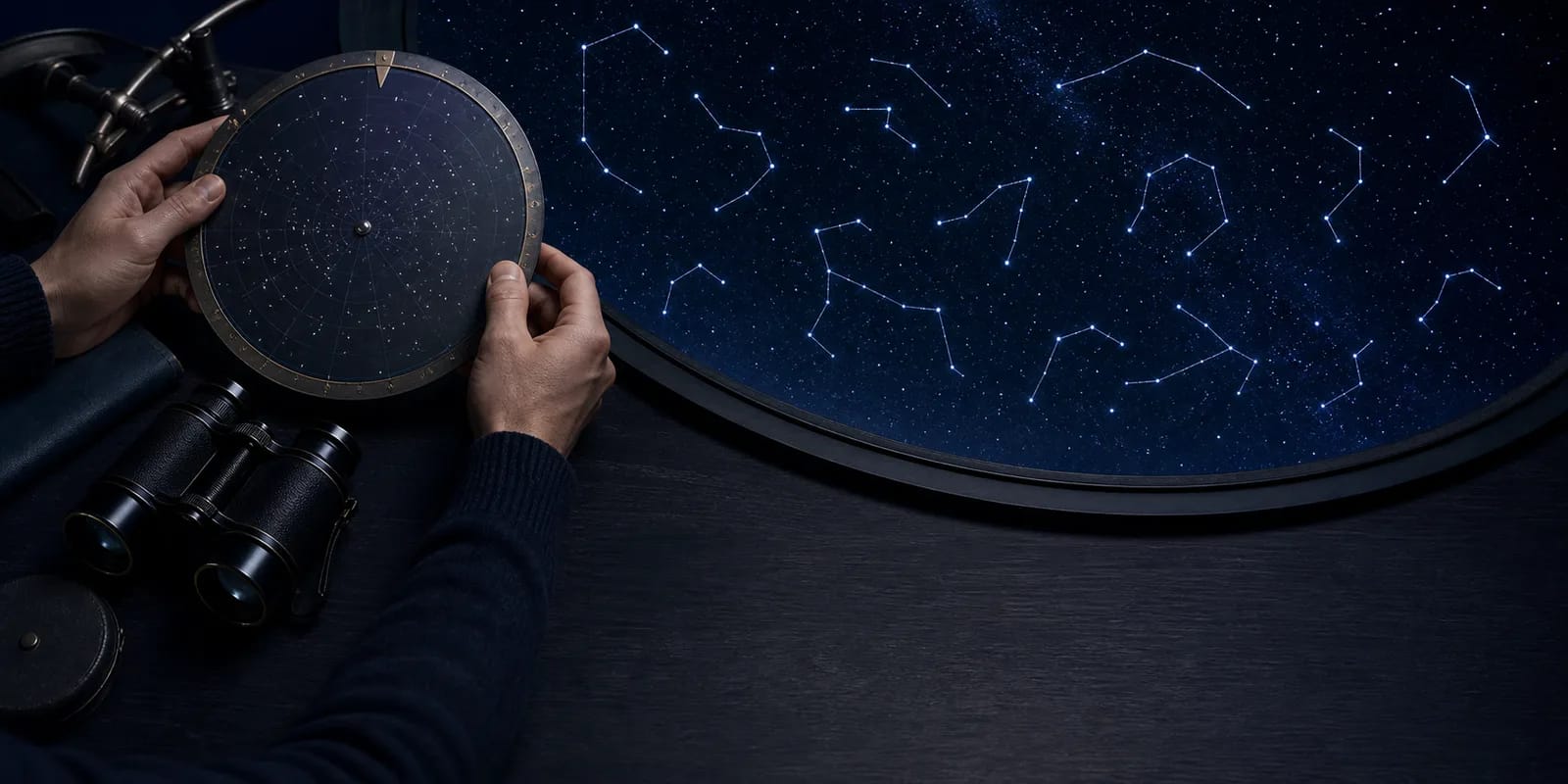
Constellations appear on the map as lines connecting the brightest stars in each group. These aren't arbitrary groupings: the International Astronomical Union (IAU) has defined 88 official constellations, each with precise boundaries. Every point in the sky belongs to exactly one constellation.
The easiest ones to spot on a star map:
- Ursa Major (the Great Bear) — famous for the Big Dipper asterism, visible year-round from northern latitudes
- Orion (the Hunter) — unmistakable with its three-star belt, dominant in winter skies
- Cassiopeia — its distinctive "W" shape, circumpolar from the U.S. and Europe
- Scorpius (the Scorpion) — with the red supergiant Antares at its heart, best seen in summer
- Cygnus (the Swan) — the great cross of the summer sky, set in the Milky Way
If you're in the southern hemisphere, look for Crux (the Southern Cross) — the iconic four-star pattern that points toward the south celestial pole.
Star Magnitude: Understanding the Brightness Scale
Magnitude is the system astronomers use to measure how bright a star appears. It's counterintuitive, inherited from the Greek astronomer Hipparchus (2nd century BC): the lower the number, the brighter the star. A difference of 5 magnitudes corresponds to a factor of 100 in brightness.
| Magnitude | Visibility | Example |
|---|---|---|
| -1.46 | Very bright, visible in cities | Sirius (brightest star in the sky) |
| 0 | Very bright | Vega |
| 1-2 | Bright, visible anywhere | Aldebaran, Arcturus, Betelgeuse |
| 3-4 | Visible to naked eye in decent conditions | Stars in Orion's Belt |
| 5-6 | Visible only under dark skies | Faint stars, Milky Way begins |
| 6.5 | Limit of human vision | Faintest detectable stars |
In total, roughly 9,096 stars are visible to the naked eye from Earth (magnitude ≤ 6.5), but in practice you'll see only a few hundred to a few thousand depending on light pollution.
On your star map, you don't need to know the numbers. The size of the dot tells the story: bigger dot = brighter star. Smaller dot = fainter star.
Zodiac Signs vs. Astronomical Constellations
This is one of the most common sources of confusion. Many people receive a star map of their birthday and look for "their constellation" — their zodiac sign. But astronomy and astrology don't work the same way.
The 12 Zodiac Signs (Astrology)
Astrology divides the ecliptic (the Sun's apparent path across the sky) into 12 equal sectors of 30 degrees each. These sectors are the "signs." The dates for each sign were established over 2,000 years ago and haven't been updated since — but the sky has shifted due to precession.
The 88 Constellations (Astronomy)
Astronomical constellations are real regions of the sky with irregular boundaries and vastly different sizes. The Sun actually passes through 13 constellations over the course of a year — the 12 zodiac constellations plus Ophiuchus (the Serpent Bearer).
What This Means for Your Star Map
If you were born on March 15, your astrological sign is Pisces. But the constellation actually visible in the sky on that date may be different — it depends on the time, your latitude, and even the year. On a star map, what you see is the real sky, not the astrological zodiac.
This doesn't make the map less special — it makes it more truthful. It's the sky as it actually was, not as astrology says it should have been.
Reading Your Personalized OwnStarMap
OwnStarMap star maps use the HYG v4.2 star catalog, which combines data from three major astronomical databases. Each map displays over 8,921 stars visible to the naked eye (down to magnitude 6.5) and all 88 IAU constellations.
The stereographic projection preserves constellation shapes faithfully, and positions are calculated using official astronomical algorithms — sidereal time, equatorial-to-horizontal coordinate conversion, then projection onto the plane.
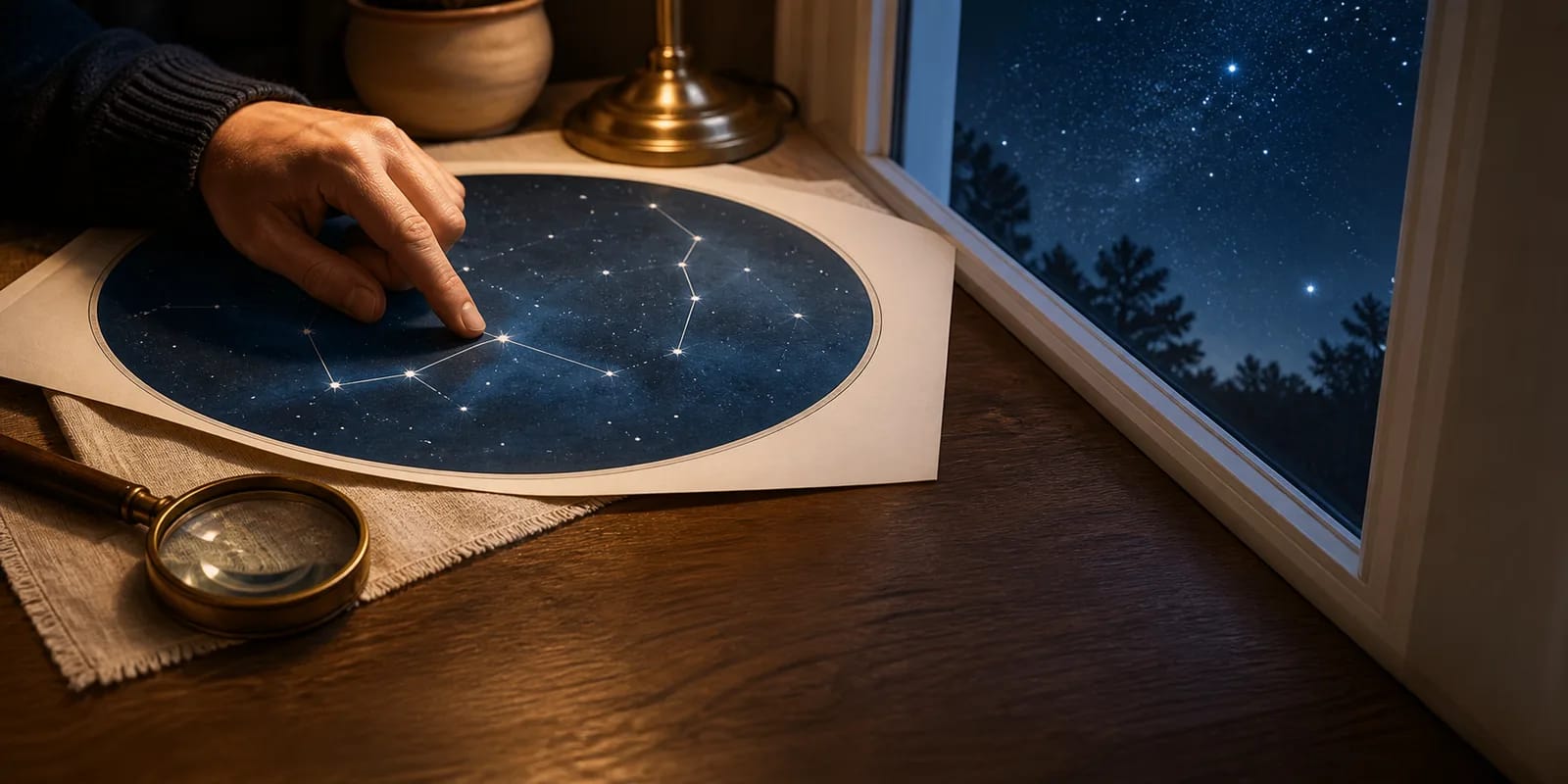
To compare your star map with the real sky:
- Wait for a clear night, away from light pollution — rural areas and dark sky reserves offer the best views
- Hold the map above your head with North on the map pointing toward true north
- Identify the brightest constellations first — Orion in winter, Cygnus in summer
- Follow the constellation lines to locate fainter stars
- Remember the sky rotates through the night — your map corresponds to one specific moment
Create Your Own Star Map
Now that you know how to read a star map, create your own. Choose a date that matters — your birthday, your wedding, the night you first met — and discover which stars were shining above you at that exact moment.
Head to the design tool and try it for free. Your map is generated in seconds, with over 8,921 real stars and all 88 IAU constellations.
The sky is full of stories. Your star map tells yours.
Frequently asked questions
How do I tell if a bright point is a star or a planet on my map?
Personalised star maps typically show stars but not planets, because planetary positions change constantly. If you're trying to identify something in the real sky, check our guide Star, planet or satellite: how to tell them apart. The key trick: stars twinkle, planets don't.
Does my star map show the Milky Way?
It depends on the design you choose. On an OwnStarMap, all 88 constellations and over 8,921 stars are displayed. The concentration of stars along the Milky Way band is visible through dot density — particularly in Cygnus, Sagittarius and Scorpius.
Is the map the same if I change the time by a few minutes?
For small shifts (a few minutes), the difference is imperceptible. The sky moves about 1 degree every 4 minutes. For gaps of an hour or more, constellations will have shifted noticeably — a star at the zenith could be 15 degrees further west.
Is my star map scientifically accurate?
Yes. OwnStarMap maps use the HYG v4.2 catalogue (Hipparcos, Yale, Gliese) and astronomical calculation algorithms with sub-arcsecond precision. For details, see our article Are star maps accurate?.
Ready to capture your special moment?
Create a personalized star map in minutes.
Design my Star Map — from 12,00 €