The 30-second test
A bright point in the night sky could be a star, a planet, an artificial satellite, an aircraft, or the International Space Station. The good news: telling them apart requires no telescope, no app and no prior knowledge. Three criteria are all you need — twinkling, movement and colour — and the diagnosis takes less than 30 seconds.
Here's the method.
Criterion 1: is it moving?
This is the first filter and the fastest. Stare at the bright point for 10 seconds.
It moves visibly across the sky?
- Steady movement, no blinking → Artificial satellite or ISS
- Movement with red/green/white flashing → Aircraft
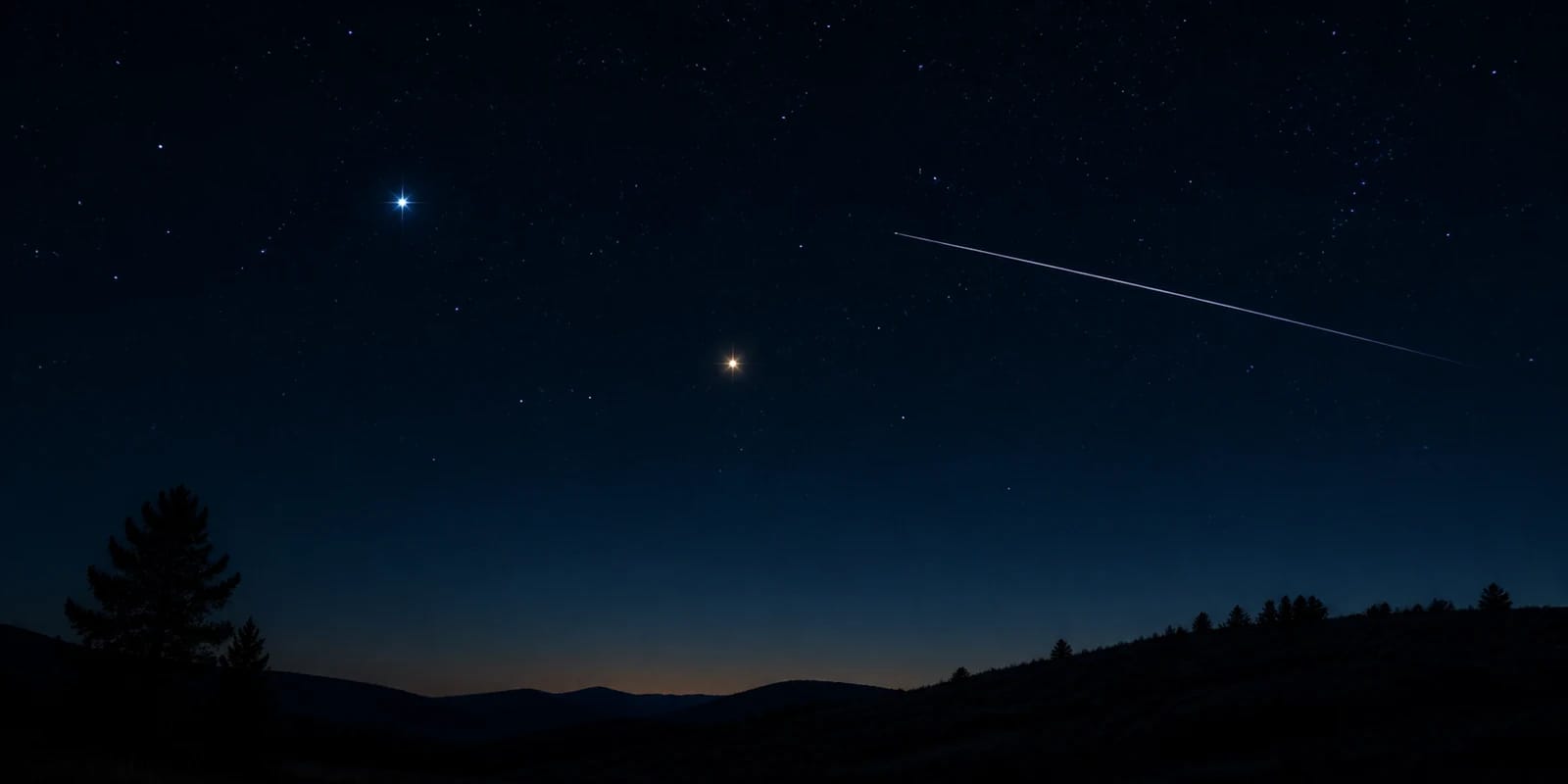
- Brief intense flash then gone → Iridium flare (satellite glint)
- Irregular or very slow movement → Drone, lantern, or optical illusion
It doesn't move (or appears fixed)?
- Move on to criterion 2.
Stars and planets don't move perceptibly over a few minutes. They drift from east to west over hours, but this motion is too slow to notice with the naked eye over a short interval.
Criterion 2: does it twinkle?
This is the most reliable criterion for telling a star from a planet, and it works 100% of the time.
The point of light shimmers, twinkles, fluctuates in brightness? → It's a star.
The point shines with a steady, fixed, unwavering light? → It's a planet.
Why stars twinkle and planets don't
Stars twinkle because they are so far from Earth that they appear as point sources of light — mathematical points with no apparent size. Their light passes through Earth's atmosphere, where layers of air at different temperatures act as unstable lenses. These lenses bend the beam of light slightly in random, rapidly changing directions. Astronomers call this atmospheric scintillation.
Planets, on the other hand, are much closer to Earth. Even though the naked eye can't perceive it, they appear as tiny discs — not points. Their light comes from multiple points across that disc, and the scintillation from each point averages out. The result: a steady, even glow with no flickering.
This is the simplest and most reliable way to distinguish a star from a planet with the naked eye. No telescope needed.
Exception: When a star is very low on the horizon, it can twinkle so strongly that it appears to change colour (red, blue, green) — this is normal, the atmosphere is thicker near the horizon. Sirius, the brightest star in the sky, is famous for its multicoloured twinkling when it's low.
Criterion 3: what colour and brightness?
Colour and intensity can confirm your identification.
The planets visible to the naked eye
Five planets in our solar system are visible without any equipment. They've been known since antiquity — the word "planet" comes from the Greek planetes, meaning "wandering star", because they shift position relative to the fixed stars over weeks.
| Planet | Max brightness | Colour | How to spot it |
|---|---|---|---|
| Venus | -4.6 (extremely bright) | Brilliant white | Always near the Sun: visible at dawn or dusk, never in the middle of the night. Called the "morning star" or "evening star". |
| Jupiter | -2.9 (very bright) | Yellow-white | Very bright, absolutely steady glow. Visible all night when at opposition. |
| Mars | -2.9 (at opposition) | Red-orange | Distinctive colour. Brightness varies enormously depending on distance from Earth. |
| Saturn | +0.5 | Pale yellow | Moderate brightness but perfectly steady. Subtle golden hue. |
| Mercury | -1.9 (max) | Variable | Always very close to the horizon, visible only a few days per month, at dusk or dawn. Difficult. |
Tip: Venus and Jupiter are so bright they can't be mistaken for stars once you know them. Venus is the third brightest object in the sky after the Sun and Moon. Jupiter is the fourth.
Star colours
A star's colour reveals its surface temperature. This isn't an atmospheric effect — it's a real physical property.
| Colour | Temperature | Examples | Season |
|---|---|---|---|
| Blue-white | 10,000 - 30,000°C | Rigel, Vega, Sirius | Winter (Rigel), Summer (Vega) |
| Yellow-white | 5,500 - 7,500°C | Procyon, Capella | Winter |
| Orange | 3,500 - 5,000°C | Arcturus, Aldebaran | Spring (Arcturus), Winter (Aldebaran) |
| Red | 2,500 - 3,500°C | Betelgeuse, Antares | Winter (Betelgeuse), Summer (Antares) |
Our Sun, with a surface temperature of about 5,500°C, is a yellow star — right in the middle of the scale.
Artificial satellites: how to identify them
Artificial satellites are increasingly numerous in the night sky. In 2026, over 12,000 active satellites orbit the Earth, including roughly 6,500 Starlink satellites from SpaceX. Here's how to recognise them.
Satellite characteristics
- Steady, constant movement: crosses the sky from one horizon to the other in 3 to 6 minutes
- No blinking: continuous light (unlike an aircraft)
- No sound: completely silent (unlike an aircraft)
- Direction: generally west to east (direction of orbit)
- Sudden disappearance: enters Earth's shadow and switches off abruptly
The International Space Station (ISS)
The ISS is the easiest satellite to spot. It shines at magnitude -4 (as bright as Venus) and crosses the sky in about 5 minutes. It's visible to the naked eye as a bright, steady, white light. Passes are predictable — you can check NASA's website (spotthestation.nasa.gov) for times from your city.
Starlink trains
SpaceX's Starlink satellites are sometimes visible as "trains" — a line of bright dots moving in a straight line, evenly spaced. This phenomenon is most visible in the days after a launch, before the satellites reach their final orbit. Over time, they grow dimmer and harder to observe.
False stars: what can fool you
An approaching aircraft
An aircraft flying directly towards you can appear stationary for a few seconds, resembling a very bright star. The difference: wait 10 seconds. The aircraft will eventually drift sideways, and you'll notice its navigation lights (red on the left, green on the right, flashing white).
Venus at twilight
Venus is so bright that it's regularly reported as a UFO. If you see an extremely bright point just after sunset or just before dawn, it's almost certainly Venus.
A drone
Modern drones have LED lights that can resemble stars. But they change direction abruptly, can hover in place, and generally emit an audible buzzing within 100 metres.
Summary: the complete decision tree
-
Moving rapidly? (crosses sky in minutes)
- Constant motion, no blinking → Satellite
- Red/green flashing → Aircraft
- Brief intense flash → Satellite glint (Iridium flare)
-
Not moving? Does it twinkle?
- Yes, it shimmers/twinkles → Star
- No, steady and fixed → Planet
-
When in doubt:
- Extremely bright, near horizon at twilight/dawn → Venus
- Very bright, yellow-white, high in the sky → Jupiter
- Distinctive red-orange colour → Mars (if steady) or Betelgeuse/Antares (if twinkling)
Frequently asked questions
Why does a star seem to change colour near the horizon?
When a star is low on the horizon, its light passes through a much thicker layer of atmosphere. Different wavelengths (colours) are refracted differently — like through a prism. The star then appears to flash red, blue and green. This is particularly spectacular with Sirius in winter. It's not your eyesight — it's atmospheric physics.
Can you see galaxies with the naked eye?
Yes, but only four. The Milky Way (our own galaxy, seen from the inside), the Andromeda Galaxy (M31, visible as a fuzzy patch in the constellation Andromeda), and the two Magellanic Clouds (visible only from the Southern Hemisphere). Every other galaxy requires a telescope.
How many satellites can you see in one night?
On a clear night, you can expect to see between 5 and 15 satellites per hour of observation, within 2 hours of sunset or before sunrise. During deep night, satellites are in Earth's shadow and become invisible — except the ISS during certain passes.
What is a "shooting star"?
It's not a star. It's a meteoroid — a fragment of space rock or dust, often no bigger than a grain of sand — entering Earth's atmosphere at 11 to 72 km/s. Friction with the air heats it to several thousand degrees, creating the visible streak that lasts a fraction of a second. "Meteor showers" (Perseids in August, Geminids in December) occur when Earth passes through debris left by a comet.
Is there an app that can identify what I'm looking at?
Yes. Point your phone at the sky using apps like Stellarium (free, open source), Sky Map, or Star Walk. They use your phone's GPS and gyroscope to overlay a map of the sky on your camera view, identifying stars, planets, satellites and constellations in real time.
Ready to capture your special moment?
Create a personalized star map in minutes.
Design my Star Map — from 12,00 €