What is a star map?
A star map is commemorative wall art built around a location, date, and time. The inputs influence the design, but the poster is not intended for observation planning or astrometric work. OwnStarMap’s public method page explains the current calculation, rendering choices, and limits.
In practical terms, a personalized star map creates a visual answer to one question: what did the selected date and place contribute to this design? It sits at the intersection of astronomy and emotion. Catalogue stars supply the sky layer, while typography, constellation lines and other overlays shape the commemorative artwork.
How does a personalized star map work?
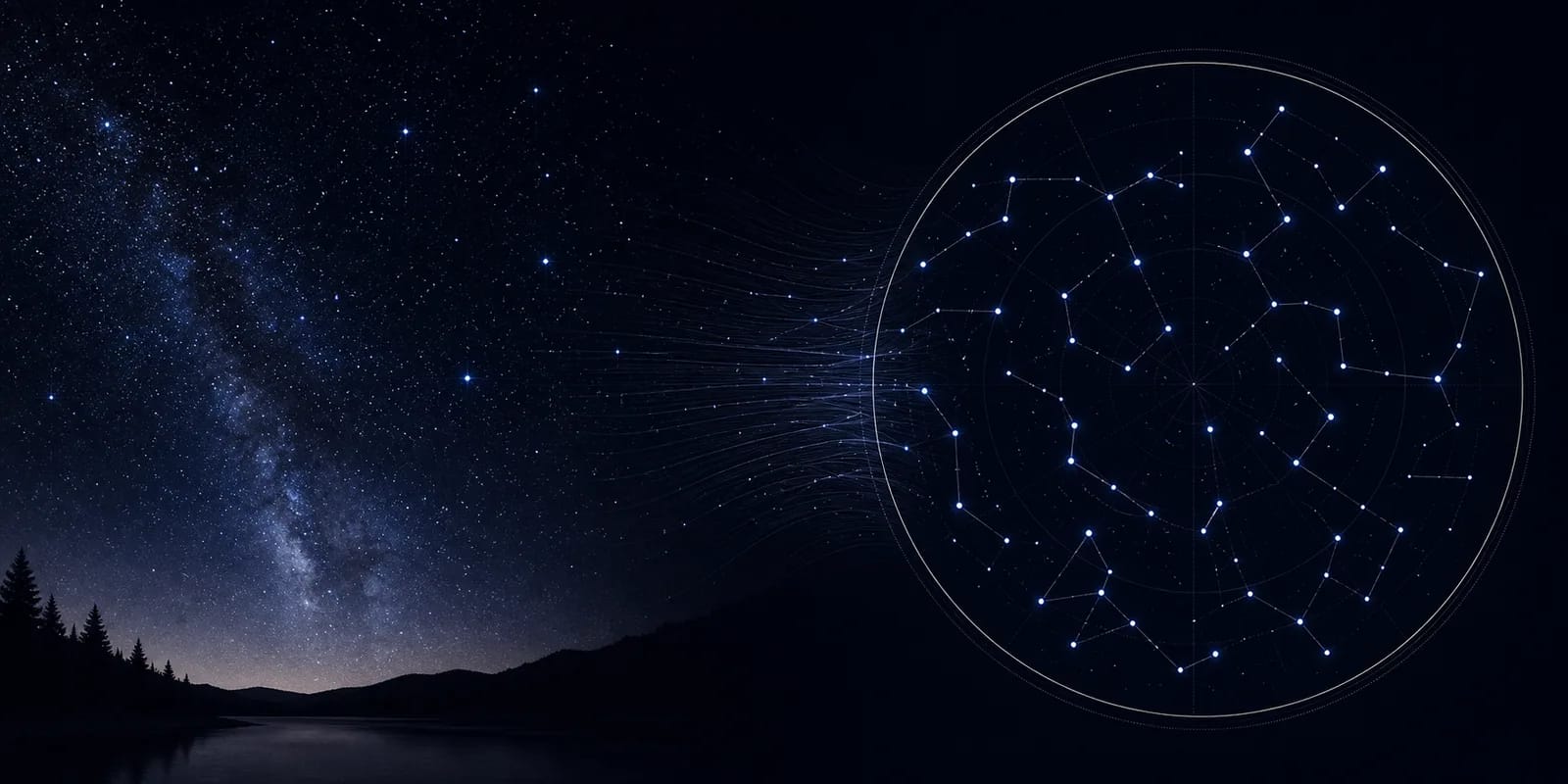
Behind the beauty of a star map lies a chain of astronomical calculations. Here is how the process works, step by step.
The starting point: your coordinates
Everything begins with three pieces of information: a date, a time, and a location. These three parameters are enough to define a unique sky among billions of possible configurations. The location is converted to latitude and longitude, and the date into a universal time reference.
The star catalog
Stellar catalogues are one possible input for this kind of visualization. When a source and its version matter, they should be documented by the tool that uses it:
- Hipparcos — Data from the European Space Agency's satellite, launched in 1989 and operational until 1993. Hipparcos measured the positions of over 118,000 stars with a precision on the order of a milliarcsecond — roughly a thousand times better than ground-based observations of the era. It forms the backbone of positional accuracy.
- Yale Bright Star Catalog — The reference census of the brightest stars in the sky, maintained by Yale University since 1930.
- Gliese Catalog — Complementary data on stars near our solar system, within a radius of 25 parsecs (about 82 light-years).
The number of points visible in a design depends on the chosen context, horizon, shape, and rendering rules; it should not be inferred from a source-file total.
Sidereal time calculation
The Earth rotates on its axis in 23 hours and 56 minutes (the sidereal day) while orbiting the Sun. The result: at two different times from the same location, you see different stars. To determine which portion of the sky is visible, the algorithm calculates the Local Sidereal Time in three steps:
- The date and time are converted into a Julian date — a continuous day count used in astronomy since the 16th century, which eliminates all calendar complications.
- The tool converts the chosen time into the coordinate system required by its implementation; consult the method documentation for the exact model and corrections used.
- The observer's longitude is added to obtain local sidereal time.
Coordinate conversion
Every star in the catalog has equatorial coordinates: right ascension and declination. These are "absolute" coordinates — they do not change with the observer. Sirius is always at the same position on the celestial sphere.
But what matters for your map is the local view: which stars are above the horizon, and where are they in your sky? The algorithm converts equatorial coordinates to horizontal coordinates (altitude and azimuth) using spherical trigonometry, the observer's latitude, and the local sidereal time. Stars with a negative altitude — below the horizon — are excluded.
Stereographic projection
The sky is a hemisphere. A poster is flat. To bridge the two, the map uses a stereographic projection — a mathematical technique used in celestial cartography since Hipparchus of Nicaea in the 2nd century BCE.
The stereographic projection has two properties that make it ideal for star maps: it preserves angles (so constellation shapes remain recognizable) and it maps circles to circles (so the horizon remains a perfect circle on the map). The center of the map corresponds to the zenith — the point directly above your head.
The final rendering
The IAU defines constellation regions, while the familiar lines connecting stars are visual conventions that vary by atlas. A poster can use those lines as reading aids; it should not claim to reproduce every condition of an observed night sky.
For a deeper technical explanation, see our article on the algorithms behind star maps.
What does a star map show?
What it shows
- Stars and labels — The visible points and labels depend on the selected context and the renderer’s display rules.
- Constellation lines — Traditional line figures such as Orion, Ursa Major, Cassiopeia, and Scorpius are reading aids rather than official IAU geometry.
- The Milky Way — The diffuse band of our own galaxy, whose appearance varies considerably depending on season and location. A summer sky in the Northern Hemisphere features a spectacular Milky Way stretching across the heavens.
- The horizon circle — The boundary between the visible sky and the ground. Everything inside the circle was above the horizon at your date and time.
What it does not show
- Planets — Mercury, Venus, Mars, Jupiter, and Saturn are visible to the naked eye, but their positions are not included. Unlike stars, whose positions are virtually fixed on the celestial sphere, planets constantly move along the ecliptic, and including them would require a separate planetary ephemeris calculation.
- Deep-sky objects — Nebulae, distant galaxies, and star clusters are not plotted (with the exception of the Milky Way itself). Although a few are visible to the naked eye (such as the Andromeda Galaxy or the Pleiades cluster), they are not part of the standard rendering.
- Artificial satellites — The International Space Station or Starlink satellites, while sometimes visible, are not plotted. They are fast-moving objects, not celestial bodies.
- The Moon and the Sun — Their positions are not shown, although their presence (or absence) influences what the human eye actually perceives of the night sky.
Star map vs. birth chart vs. planisphere
These three objects share a connection to the sky, but they are fundamentally different. Here is a factual comparison.
| Star map | Birth chart (astrological) | Planisphere | |
|---|---|---|---|
| Basis | Commemorative visualization | Astrology — symbolic interpretation | Simplified astronomy |
| Data | Date, time, location, and renderer settings | 10 celestial bodies (Sun, Moon, planets) | Fixed constellations |
| Customization | Specific date + time + location | Date + time + place of birth | Fixed latitude, adjustable date |
| Shows | Stars as they actually were in the sky | Symbolic positions of planets in zodiac signs | Constellations visible on a given date |
| Purpose | Commemorative, decorative, educational | Personality interpretation, predictions | Sky observation tool |
| Technical use | Read the tool’s method and limits | Not applicable — symbolic framework | Approximate (manual rotation) |
| Format | Digital or printed poster | Circular diagram with 12 houses | Physical rotating disk |
To be clear: a star map is not an astrological tool. It says nothing about your personality, your future, or your romantic compatibility. It shows the stars as they were arranged in the sky, full stop. That is astronomy, not astrology.
That said, astrology and astronomy share a common root — the observation of the sky by ancient civilizations. A birth chart interprets celestial positions through a symbolic framework. An OwnStarMap poster is a commemorative design, and its technical scope is described on the public method page.
A planisphere, meanwhile, is a practical observation tool: a rotating disk that shows which constellations are visible at a given latitude for any date of the year. It is generic — not customized for a specific date and location — and it does not display individual stars with their real brightness.
Why give a star map as a gift?
People who give star maps share a common motivation: turning a moment that matters into a lasting, beautiful object. Here are the most common occasions, and what makes the gesture so meaningful in each case.
The day a child is born
When a baby arrives, the sky above the hospital is unique. Parents who order a birth star map are not just decorating the nursery — they are creating a time marker. "These are the stars that welcomed you." Twenty years later, that child can look at their map and see the exact sky of their first night. It is a birth poster that never expires.
A wedding or engagement
On the night of a wedding or a proposal, the sky is the silent witness. A star map of that night turns an abstract memory into a tangible object. Many couples hang it in their living room with the location and date inscribed beneath — not as a museum piece, but as a daily reminder.
A wedding anniversary
Whether it is a paper anniversary (1 year), silver (25 years), or golden (50 years), revisiting the sky of your wedding day decades later carries deep emotional weight. The couple has changed, life has moved on, but the stars of that night remain the same.
A tribute
After the loss of someone close, some people choose to capture the sky of the night they were born or the day they left. It is a quiet, personal tribute — not a monument, but a presence on the wall that says: "You were here, under these stars."
Other moments
The evening of a first meeting. The night of moving into a new home. The day of a graduation or a retirement. Any moment worth marking can become a star map. What makes the gift unique is that it is not generic: it is tied to a specific instant in the recipient's life.
How to verify a star map's accuracy
You do not have to rely on marketing language. Use the public method, your inputs, and independent software when you want to compare a design with a separate reference.
Step by step with Stellarium
- Download Stellarium — It is a free, open-source planetarium program, available at stellarium.org. It is used by amateur and professional astronomers worldwide.
- Set the location — Enter the same city (or the same GPS coordinates) as on your star map.
- Set the date and time — Enter the exact date and time.
- Compare the constellations — Verify that the same constellations appear in the same regions of the sky. Orion should be in the same place, Ursa Major as well.
- Check the horizon — Stars below the horizon in Stellarium should not appear on your map. If they do, the horizon filtering is not working correctly.
- Spot the bright stars — Sirius, Vega, Arcturus, and Capella should be in the same relative area in both representations.
Automated verification
OwnStarMap publishes a method page so a buyer can see the intended scope and important exclusions. For observational or scientific work, use software that documents the models required for that purpose.
For more detail, our article on star map accuracy walks through every link in the precision chain.
How to create your star map
The process takes less than five minutes.
- Open the design tool — Go to ownstarmap.fr/design. No account needed.
- Enter your date, time, and location — The tool auto-recognizes over 50,000 cities and places worldwide. The sky is calculated in real time as you type.
- Customize the design — Choose the color theme, poster shape, typography, and add a personal message (title, subtitle, location and date).
- Choose a format or order — Review the current checkout terms for available files, prints, and fulfilment timing.
The preview updates as you adjust time and location. It is an interactive design tool, not a substitute for complete astronomical simulation software.
Frequently asked questions
Is a star map a horoscope?
No. A horoscope falls under astrology: it symbolically interprets the positions of the Sun, Moon, and planets to derive predictions or personality portraits. A star map is a visual keepsake around a chosen time and place. It makes no predictions and should not be confused with professional astronomical software.
How many stars appear on a star map?
There is no single “correct” number of points for every decorative map. The selection varies with the context and the display rules. When comparing providers, ask them to disclose their current method instead of treating a large count as proof of accuracy.
Can I create a star map for a future date?
Yes. The astronomical engine works for any date between 1900 and 2100. You can create a star map for an upcoming event — a planned wedding, an expected birth, a future birthday. Star positions are calculated with the same precision as for past dates, because the fixed stars do not shift perceptibly over a few centuries (their proper motion is imperceptible at human timescales).
Are star maps a good gift?
Yes, and what sets them apart from other personalized gifts is the combination of three qualities: they are unique (no two moments in time produce the same sky), they are meaningful (tied to a specific memory), and they are lasting (a poster that hangs on a wall and is looked at for years). It is a gift that resonates with astronomy enthusiasts and people who simply appreciate a thoughtful gesture alike. For occasion ideas, see our gift occasions guide.
What is the difference between a star map and "naming a star"?
They are different products. Services that offer to “name a star” sell a certificate assigning a custom name; that name is not an official astronomical designation. A star map, by contrast, is a visual keepsake built from chosen details. For a detailed comparison, see our article star map vs. naming a star.
Are all star maps the same from one site to another?
No, and the differences can be significant. The quality of a star map depends on the star catalog used, the precision of the calculation algorithms, the type of cartographic projection, and the number of constellations drawn. Some providers use simplified catalogs with a few thousand stars, projections that distort constellation shapes, or approximate constellation lines. Others fail to filter the horizon properly, displaying stars that were actually below the horizon line. Our star map site comparison analyzes these differences in detail.
Ready to capture your special moment?
Create a personalized star map in minutes.
Design my Star Map — from 12,00 €