The Short Answer
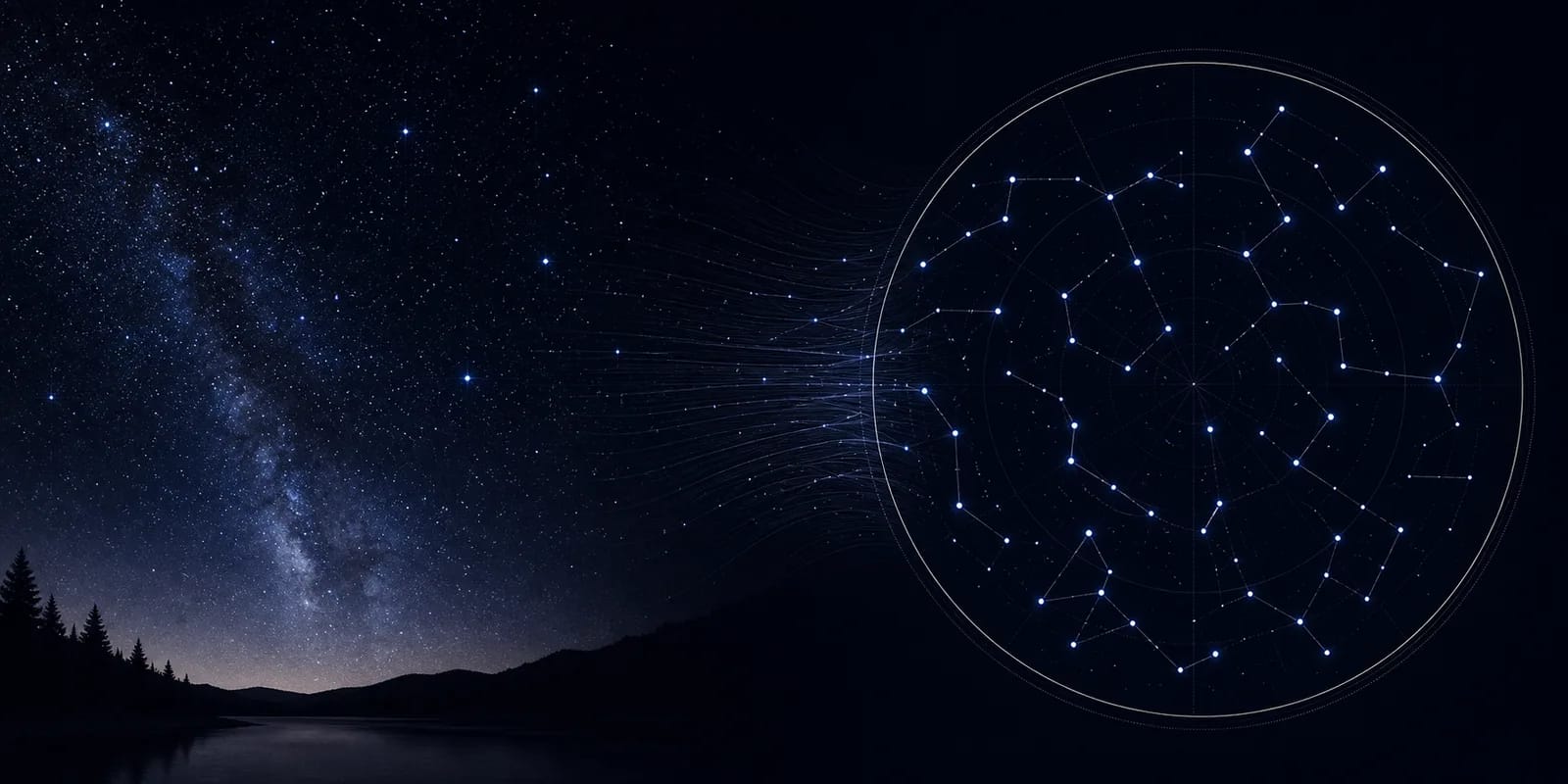
A star map is a projected celestial sphere — a geometric, top-down rendering of the sky as it actually appeared from a specific date, time, and GPS coordinate, with constellation lines, named stars, and a circular disc bounded by the horizon. A night sky print is a broader, often artistic interpretation: anything from a photo-style depiction of the Milky Way to a stylized scene with a foreground, moon, and atmospheric color gradients. Star maps prioritize astronomical accuracy (OwnStarMap uses the HYG catalog v4.2 with 8,921 stars and 88 IAU constellations); night sky prints prioritize visual atmosphere. Both look beautiful on a wall, but they answer different questions.
Terminology Matters (Because Sellers Mix It Up)
The terms "star map," "star chart," "celestial map," and "night sky print" are used loosely across the internet, and the confusion costs people money.
Star map — A scientific rendering of the night sky for a specific moment. Uses stereographic (or orthographic) projection. Shows individual stars, often the named stars, and the constellation lines connecting them. Typically a circle representing the visible hemisphere from a given location at a given moment.
Star chart — Used interchangeably with "star map" in most contexts.
Celestial map — Same projection logic, but often shows the full celestial sphere rather than a single hemisphere. More common as a historical or decorative reference.
Night sky print — The most ambiguous term. Can mean any of the above, or a generic illustration of stars on a dark background with no astronomical accuracy. The label tells you almost nothing about what you're buying.
If a seller advertises a "personalized night sky print" and the preview shows a circular sky disc with constellation lines and named stars labeled, that's a star map under a different name. A wash of decorative stars with no labels and no clear projection is an artistic print.
Scientific Accuracy: How They Differ
Star maps are generated from astronomical catalogs. OwnStarMap uses the HYG database v4.2 (combining Hipparcos, Yale Bright Star, and Gliese). Stars are filtered to magnitude 6.5 (the naked-eye limit). Each star's coordinates are converted to local altitude-azimuth for the user's date, time, and GPS location using IAU 2006 sidereal time. The result is a faithful projection of what was actually overhead.
Night sky prints vary. Some use real astronomical data with artistic post-processing. Many use stock illustrations sprinkled decoratively, with no relation to a real catalog or projection.
The litmus test: ask the seller which star catalog they use. If they can't answer, the print is artistic, not astronomical. Our public accuracy page lists the exact catalogs and algorithms OwnStarMap uses.
Personalization Depth
Star maps are deeply personalized by definition. The entire image depends on three inputs — date, time, and location. Change any one and the constellations rotate, rise, or fall.
Night sky prints vary. Some accept a date and location and adjust accordingly (effectively becoming star maps with a different visual treatment). Others only accept a name and an inscription, with the sky imagery fixed.
If the personalization options include only a name and an inscription — but the sky looks identical to every other order — you're buying decorative art with a custom caption.
Use Case Fit
Both products have their place. The question is what you want the print to do on the wall.
Pick a star map if:
- You want the gift's meaning to be verifiable ("this is exactly what the sky looked like that night")
- The recipient cares about astronomy or has scientific interests
- The personalization itself is the point — wedding date, birthday, day they met
- You want the print to function as both art and a record of a specific moment
Pick a night sky print if:
- You want decorative atmosphere more than specific accuracy
- The wall needs something celestial-themed but not literal
- You're shopping for ambiance, not memory
- The recipient is more drawn to mood than data
For most gift-giving scenarios — anniversaries, weddings, births, memorials — a star map is the better fit because the gift's value comes from being that specific night. For nursery walls, dorm rooms, or general celestial decor, a night sky print may be more flexible.
How to Tell Which One a Seller Is Offering
Three signals to check before you buy.
1. Test the preview. Enter two completely different dates (June 21 versus December 21). If the preview looks visibly different — constellations rotate, new stars appear — it's a real star map. If only the caption changes, it's decorative.
2. Check for named stars and constellation lines. A real star map labels at least the brightest stars (Sirius, Vega, Polaris) and draws connecting lines. Decorative prints usually don't.
3. Find the source catalog mentioned in the FAQ. Reputable vendors disclose: HYG, Hipparcos, Yale Bright Star, Gaia DR3. If no catalog is mentioned anywhere, the print isn't astronomically derived.
Price Range Comparison
Both products sit in similar price territory, but the breakdown differs.
Star maps at OwnStarMap start at under $30 for a digital PDF download and reach the $80–120 range for a framed 18×24 fine-art print. The price reflects the rendering cost and printing quality; the underlying data is the same across all sizes.
Night sky prints range more widely. Decorative prints on Etsy can start at $15 (essentially clipart with a custom caption); high-end artistic prints from independent illustrators can exceed $150. The price doesn't necessarily correlate with personalization depth — a $15 print might be more "personalized" than an $80 one if the more expensive option is a fine-art illustration with only a name swap.
FAQ
Can I get a star map that also has the artistic atmosphere of a night sky print?
Yes. OwnStarMap offers eight visual styles, including watercolor washes, atmospheric gradients, and minimalist monochrome. The astronomical data stays accurate; the styling changes. So you get the verifiability of a star map and the mood of an artistic print.
Are night sky prints ever scientifically accurate?
Some are. The label "night sky print" doesn't preclude astronomical accuracy — it just doesn't guarantee it. The only way to know is to check the seller's data source or test the preview tool with different dates.
Which one makes a better wedding gift?
A star map, almost always. The wedding's meaning is tied to a specific date and venue, which is exactly what a star map preserves. A night sky print without that specificity becomes a generic celestial poster.
Do star maps and night sky prints look different at a glance?
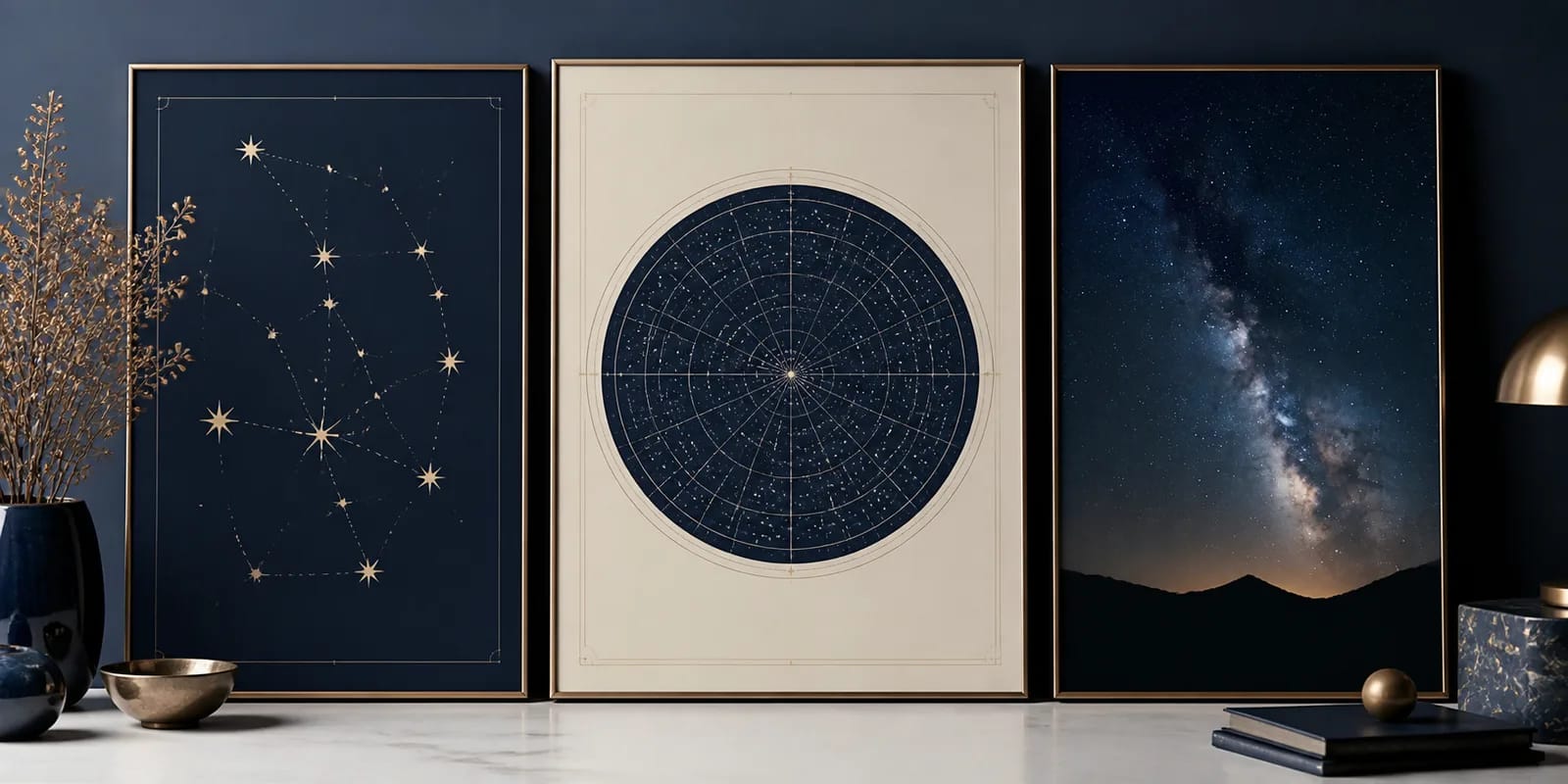
Star maps almost always show a circular sky disc with constellation lines. Night sky prints are usually rectangular and edge-to-edge, with no horizon boundary visible. If you see a perfect circle of stars on a dark field, it's a star map. If the stars fill the whole rectangle, it's likely an artistic print.
Can I order both and compare?
Yes. Digital downloads are inexpensive enough that some customers order a star map and an artistic print of the same date from different vendors, then frame whichever feels right. Most end up keeping both for different walls.
Make It
The choice between a star map and a night sky print isn't about quality — both can be beautiful — it's about what you want the print to mean. If the date and place are the point, a star map is the right answer. If the mood is the point, an artistic print works. Open the configurator to see how the projection works in real time, or read our complete guide to star maps.
Ready to capture your special moment?
Create a personalized star map in minutes.
Design my Star Map — from 12,00 €